Dundalk Courthouse, Neoclassical courthouse in Dundalk, Ireland
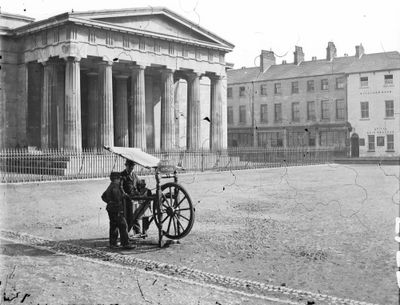
Dundalk Courthouse is a neoclassical courthouse with a symmetrical facade of ashlar stone in Dundalk, Ireland. The front facing Crowe Street displays fluted Doric columns and a six-column portico, with interior spaces adapted for modern use over time.
The building was completed in 1819 by architects Edward Parke and John Bowden and served as the administrative center for County Louth. Its neoclassical design reflected the architectural ideals of the period for British court buildings in Ireland.
The courthouse's name is tied to its role in local justice, and after the Local Government (Ireland) Act 1898 it also housed meetings of Louth County Council until the council moved to County Hall in 2000. The building was modelled on the Temple of Hephaestus in Athens, a detail visible in its six-column Doric portico facing Crowe Street.
The courthouse stands on Crowe Street, where the hexastyle portico and steps face the street; County Buildings, the former home of county officials, is also on Crowe Street. The building is an active court, so access is limited to areas open to the public on court days.
The courthouse's design was modelled on the Temple of Hephaestus in Athens, a detail visible in the six-column Doric portico facing Crowe Street. After Louth County Council moved to County Hall in 2000, the building stood disrepair until Michael McDowell, Minister for Justice, Equality and Reform, reopened it in March 2003.
The community of curious travelers
AroundUs brings together thousands of curated places, local tips, and hidden gems, enriched daily by 94,040 contributors worldwide.