Knesset Menorah, Bronze monument near the Parliament in Jerusalem, Israel
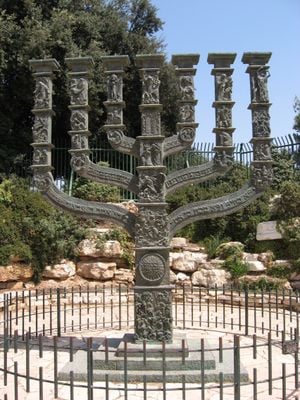
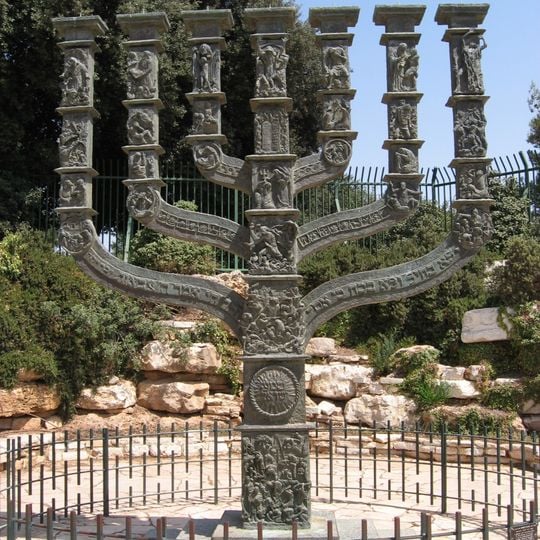
The Knesset Menorah is a bronze candelabrum 4.30 meters high and 3.5 meters wide, weighing 4 tons, standing at the edge of Wohl Rose Park opposite the Knesset in Jerusalem. Its central shaft and six curved arms are built from stacked rectangular panels carved with reliefs of figures and scenes, joined by horizontal crossbars near the top. Bands of raised Hebrew lettering run along the lower curves and around the shaft, and the dark metal shows a greenish patina.
In 1950 Edwin Samuel, son of the first British High Commissioner to Palestine, proposed a bronze menorah as a gift to the young state. Benno Elkan, a Jewish sculptor who left Germany in 1933, worked on it for years, and the Menorah Fund Committee raised 20,000 pounds by 1955. It reached Haifa by ship in March 1956 and was unveiled in Jerusalem on April 15, 1956, the eighth anniversary of independence.
The menorah's shape follows the Temple candelabrum as shown on the Arch of Titus in Rome, the same model used for Israel's state emblem. Donors paid for individual reliefs, and their names and chosen scenes are listed in English on the base, among them WIZO, Marks & Spencer and Baron James de Rothschild.
The monument sits on the Knesset grounds in Givat Ram and remains accessible to visitors year-round. The site may have security procedures in place, so arriving early gives you more time to view the sculpture at leisure.
The central stem focuses on biblical scenes while the outer branches expand into more modern national moments. This arrangement visually connects ancient spiritual foundations with the establishment of the contemporary state.
The community of curious travelers
AroundUs brings together thousands of curated places, local tips, and hidden gems, enriched daily by 92,635 contributors worldwide.