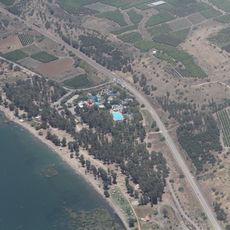
Kursi, Archaeological site and monastery in Golan Heights, Israel.
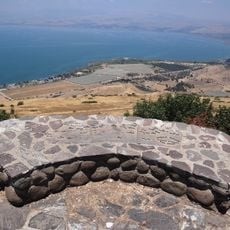
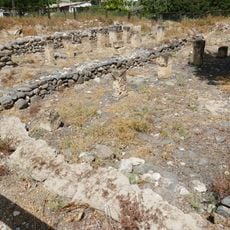
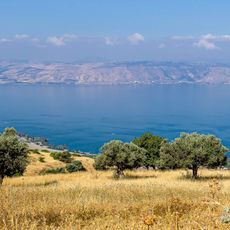
Kursi is a Byzantine monastery and archaeological site on the eastern shore of the Sea of Galilee, by Nahal Samakh in the Golan Heights. Its rectangular stone wall measures 145 by 123 metres. The basilica church, 24 by 45 metres, has two rows of white marble columns with Corinthian capitals; three arched openings and two pale column bases remain visible in the ruined walls.
The monastery and its church were built in the 5th century and served as a major pilgrimage site with walls, a watchtower and a harbor. In 614 Sassanian armies damaged many buildings, including the church, and the settlement shrank; the church was later rebuilt. It continued under Muslim rule after 638–641 until the 749 earthquake devastated it, and 9th-century Arab squatters used the ruins as dwellings.
The main church shows how Byzantine builders separated the central space with columns and filled walls with mosaic images of plants and animals. These decorations reveal what the community valued and wanted to see during worship.
The park has marked walking trails and educational signs to help visitors navigate the remains. Wear comfortable shoes and bring water, as the paths are exposed to sun with little shade protection.
A marble slab with Aramaic writing discovered in 2015 shows that Jewish or Judeo-Christian communities lived here around 500 CE. This discovery suggests that different religious groups shared the region and may have influenced each other.
The community of curious travelers
AroundUs brings together thousands of curated places, local tips, and hidden gems, enriched daily by 93,883 contributors worldwide.