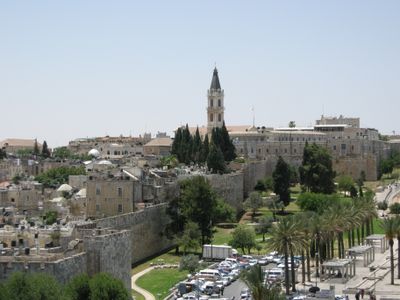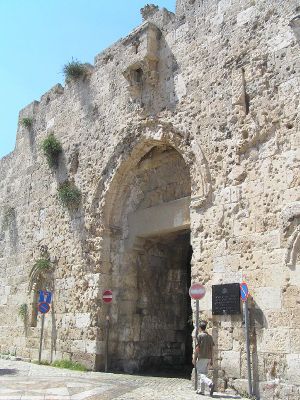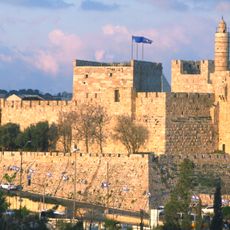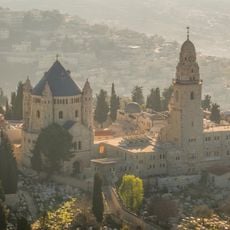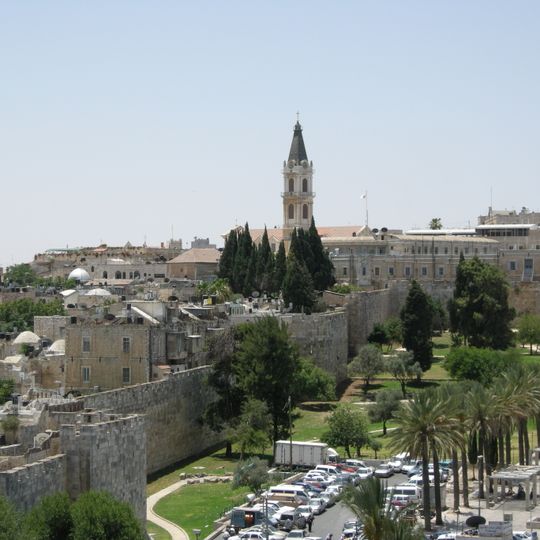
חומת ירושלים העות'מאנית, Ottoman fortification walls in Old City, Jerusalem, Israel.
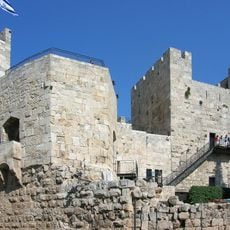
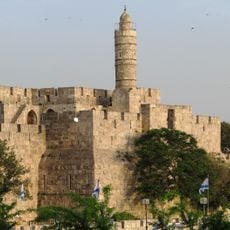
The Ottoman walls of Jerusalem run about 4.5 km around the Old City, standing roughly 10 m high but no more than 2.5 m thick. Large pale grey and tan blocks form a flat-topped parapet with crenellations, cylindrical towers and a square bastion. A pointed archway with a smoother stone panel above it opens through the masonry, and a small carved relief sits near the top.
A sultan commissioned these walls in the 16th century after the city lacked fortifications for about three centuries. The construction reused foundations and materials from much older defensive structures beneath the surface.
The walls shape how people experience the Old City today, dividing it into distinct quarters while serving as a gathering place and landmark for residents. They mark the boundary between old and new Jerusalem in the everyday life of the city.
An elevated walking path runs along sections of the walls and offers views across the Old City and surrounding areas. Wear sturdy shoes since the surface is uneven and includes steps and steep sections.
The wall was completed in only four and a half years: the Damascus Gate in the north was finished in 1538 and the Zion Gate in the south in 1542. Builders laid the new courses on older foundations and reused stones from dismantled public buildings, including churches.
The community of curious travelers
AroundUs brings together thousands of curated places, local tips, and hidden gems, enriched daily by 92,638 contributors worldwide.