Spiral House, Modern residential structure in Ramat Gan, Israel.
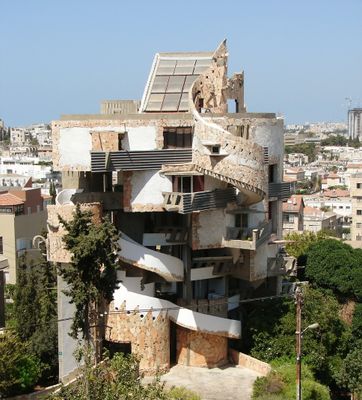
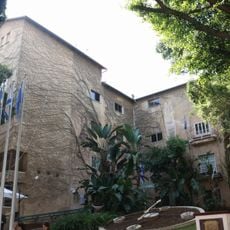
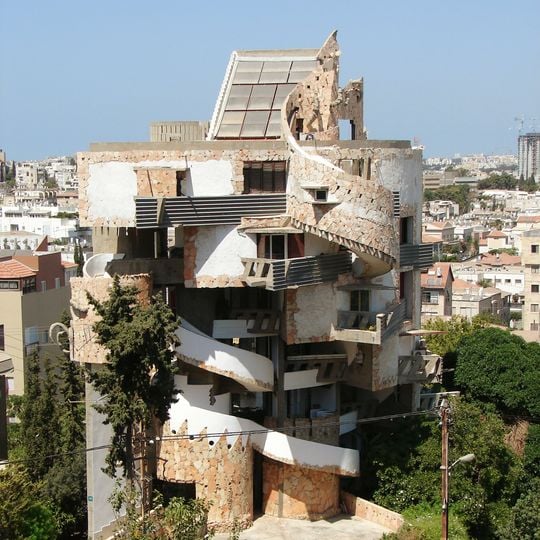
Spiral House (Beit HaSpirala) is an apartment building on the slope of a hill facing Har HaBanim at 13 Tzel HaGiva Street in Ramat Gan, built in concrete and partly clad in plaster and partly in thin pink stone, glass fragments and corrugated tin. Its form is an upward spiral, with unroofed balconies wrapping the exterior and a central inner courtyard onto which all the flats open.
Zvi Hecker designed the Spiral House with Gil Bernstein, Shmuel Groberman and Rina Hering; Jaakov Hai built it between 1984 and 1990. Hecker lived in the Dubiner house opposite the site, so he supervised construction closely and altered the design several times while it was being built. In 1999 he received the Rechter Prize for architecture for the building, shared with Ram Karmi.
The building's terraced form draws on the roof-terraces of Arab villages, where the roof serves as part of the living space. Hecker called it a "miniature Tower of Babel"; Shmuel Grobstein said it looked as if a storm had swept through Ramat Gan, gathered the wreckage from roofs and yards, and made the spiral in one swoop. Hecker's daughter Ella Zimmerman lives there with her family.
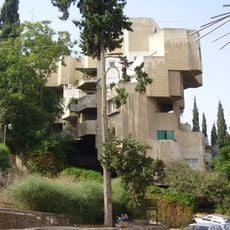
Spiral House is a private apartment building at 13 Tzel HaGiv'a Street, on a hillside facing Har HaBanim; there is no public interior to tour. Visitors view the spiral massing, the roofless balconies and the pink stone, glass-fragment and corrugated-tin cladding from the street. The Dubiner house, also by Hecker, stands opposite.
Hecker called the building a "miniature Tower of Babel", and his daughter Ella Zimmerman lives there with her family. The architect himself lived in the Dubiner house opposite, so he could supervise the work and changed the design several times during construction.
The community of curious travelers
AroundUs brings together thousands of curated places, local tips, and hidden gems, enriched daily by 92,638 contributors worldwide.