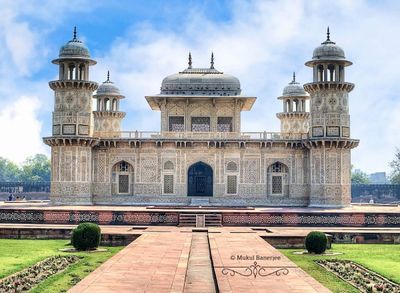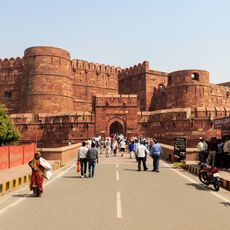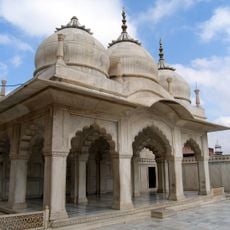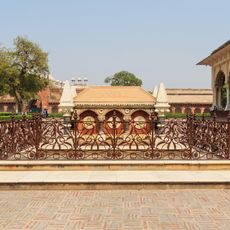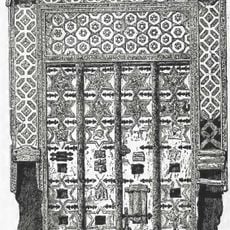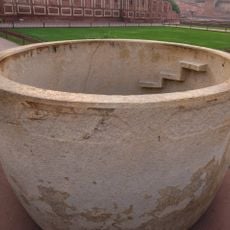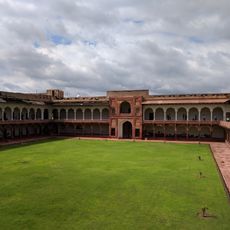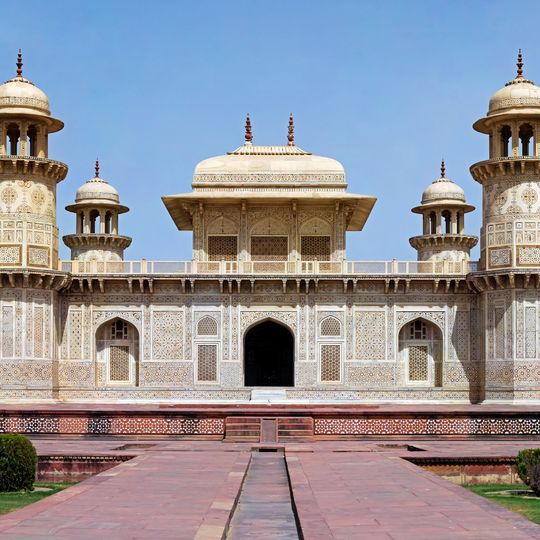
Tomb of I'timād-ud-Daulah, Mughal mausoleum in Agra, India.
The Tomb of I'timād-ud-Daulah is a Mughal mausoleum in Agra, India. White marble facades carry ornaments made from semi-precious stones depicting cypress trees and geometric patterns.
The mausoleum was built between 1622 and 1628 commissioned by Nur Jahan, wife of Emperor Jahangir, for her father Mirza Ghiyas Beg. This structure initiated the shift from red sandstone architecture to white marble during Mughal times.
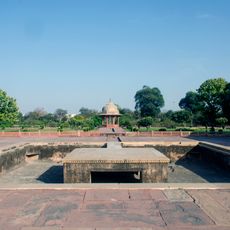
The structure follows Persian design principles with a charbagh garden layout, divided into four sections by water channels representing paradise rivers. This geometric division reflects a religious understanding of order and beauty that was widespread in the Mughal empire.
The tomb stands on the eastern bank of the Yamuna, entered through the eastern gateway, with ornamental gateways to the north and south and a riverside pavilion to the west. The charbagh is crossed by raised stone walkways with water channels along their centres. It is a centrally protected ASI monument open throughout the year, and one of five ticketed Agra monuments covered by the pathkar toll scheme, where a foreign visitor's toll at one site is valid at the others the same day.
The central hall contains cenotaphs of Mirza Ghiyas Beg and his wife, while graves of other family members rest in side chambers. The real burials lie deeper in a crypt below the floor, following Islamic tradition.
The community of curious travelers
AroundUs brings together thousands of curated places, local tips, and hidden gems, enriched daily by 92,856 contributors worldwide.