Akbar's Tomb, Mausoleum in Sikandra, India
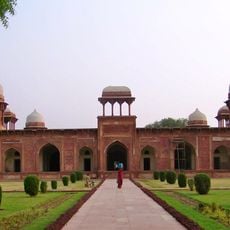
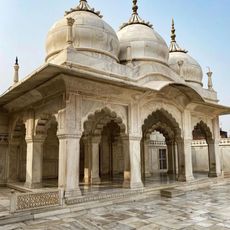
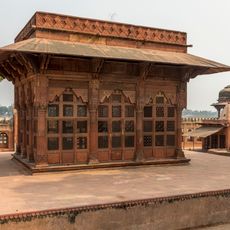
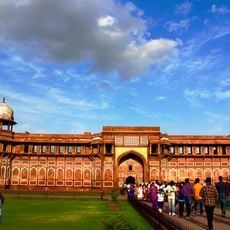
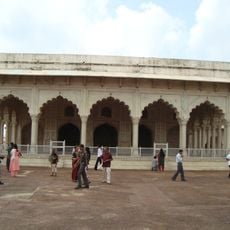
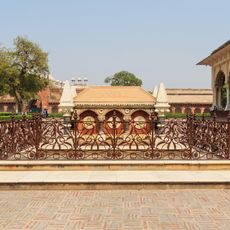
Akbar's Tomb in Sikandra is a four-tiered pyramid of deep red sandstone with white marble details, enclosed by a walled compound 105 m square. A marble pavilion tops the structure and holds the false tomb, while the true grave lies in the basement. The south gate, the largest of four, carries four white marble chhatri-topped minarets.
Akbar began the tomb himself, but it was completed by his son Jahangir between 1605 and 1613 at a cost of 1,500,000 rupees. In 1688, Jats under Raja Ram Jat ransacked the monument, opened the grave and burned Akbar's bones. George Curzon directed repairs completed in 1905.
The tomb holds a long Persian eulogy composed and inscribed by the calligrapher Abd al-Haqq of Shiraz, later titled Amanat Khan, who also provided the inscriptions for the Taj Mahal; he signed his work in three places. Inlaid panels of red sandstone, white marble and black slate carry geometric, floral and calligraphic designs.
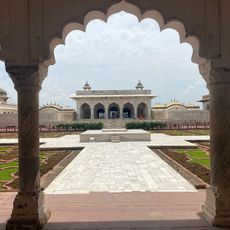
Access is through a large gate on the south side, leading into a park with pathways and lawns. Visitors should wear sturdy shoes, as the paths are stone and can be uneven in places.
Wild deer live in the courtyard and move freely between the trees and green spaces. These animals have been part of the grounds for generations and often seek shade under old trees.
The community of curious travelers
AroundUs brings together thousands of curated places, local tips, and hidden gems, enriched daily by 92,308 contributors worldwide.