Jantar Mantar, Astronomical observatory in Connaught Place, India
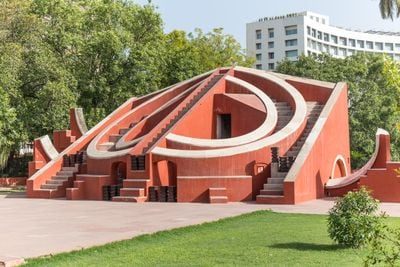
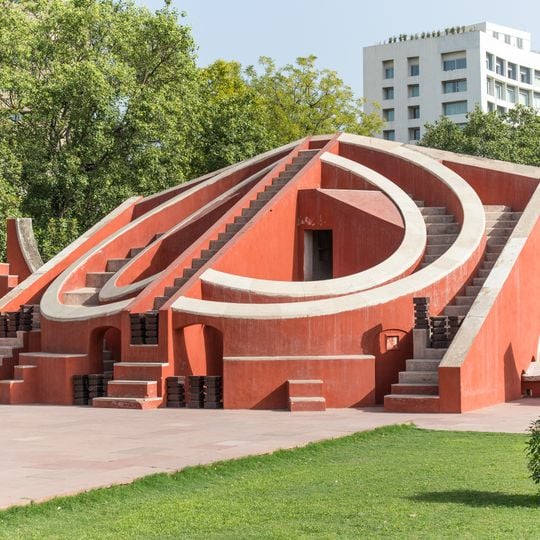
Jantar Mantar is an observatory with large stone structures in the Connaught Place neighborhood of New Delhi. The site contains thirteen instruments arranged like geometric sculptures in the open air, each serving different astronomical functions.
Jai Singh II, ruler of Jaipur, built the Delhi observatory in 1724, the first of five he erected; the others stand at Jaipur, Ujjain, Mathura and Varanasi. It was inspired by the observatory at Samarkand, and a dispute between Hindu and Muslim astronomers over planetary positions under Muhammad Shah prompted its construction. A plaque of 1910 wrongly dates the complex to 1710.
The names of the instruments come from Sanskrit and describe their function, such as "Samrat" for supreme ruler in the great sundial. Visitors today still see the original markings and scales that astronomers used to read the movement of celestial bodies.
The complex lies near the Connaught Place transport hub and is easily reached on foot from the surrounding streets. The instruments stand in the open air, so a visit in the morning or late afternoon is advisable due to the heat.
The red surfaces are plaster, not sandstone. A plaque on one structure, placed in 1910, dates the complex to 1710; later research points to 1724. The Samrat Yantra, 70 feet high with a 128-foot hypotenuse, is considered the world's largest sundial and reads local time to within two seconds.
The community of curious travelers
AroundUs brings together thousands of curated places, local tips, and hidden gems, enriched daily by 92,380 contributors worldwide.