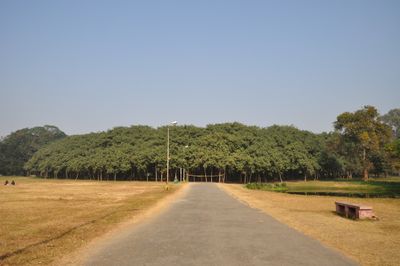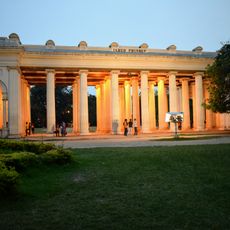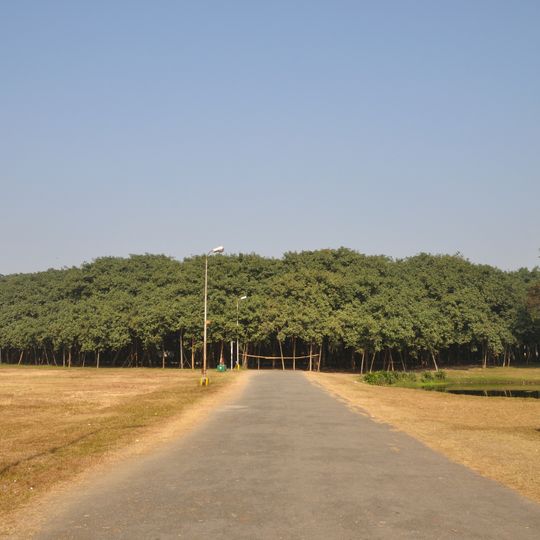
The Great Banyan, Ficus benghalensis in Acharya Jagadish Chandra Bose Indian Botanic Garden, Howrah, India.
The Great Banyan is a fig tree in the Botanic Garden of Howrah whose appearance resembles a sprawling forest. Its aerial roots reach downward and anchor themselves in the ground, so each lowered branch becomes a new supporting pillar.
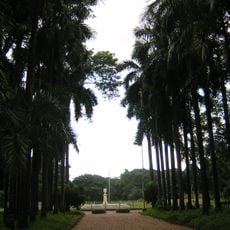
The tree is believed to be at least 250 years old and appears in travel accounts from the nineteenth century. Cyclones in 1864 and 1867 broke main branches and split it into two parts. Its main trunk, infected by fungi, was removed in 1925 to keep the rest healthy; a monument now marks the dead trunk near the centre. Cyclone Amphan damaged several prop roots on 20 May 2020.
The tree's Bengali name, বিশাল বটবৃক্ষ, means "giant banyan". Its small red figs ripen soft and are eaten by some people, and birds carry the seeds, which is why banyans sometimes sprout from damp dust on buildings. A yellow rope is tied between two prop roots in front of the tree.
A circular path allows visitors to view the tree from all sides and understand how the roots spread over time. The path runs close enough to see the structure up close without disturbing the sensitive ground.
The tree was listed in the Guinness Book of World Records in 1989 as the largest tree specimen in the world. A monument to the removed main trunk stands near the centre, but visitors rarely venture into the thick inner tangle of roots to reach it.
The community of curious travelers
AroundUs brings together thousands of curated places, local tips, and hidden gems, enriched daily by 92,699 contributors worldwide.