Jama Masjid, Mumbai, Islamic mosque in Central Mumbai, India
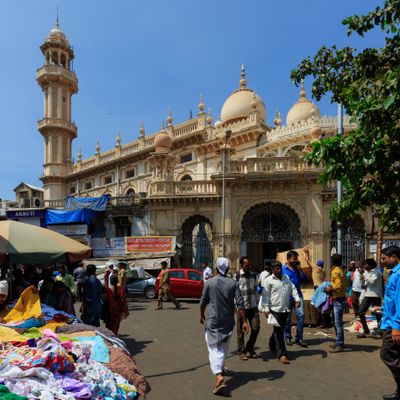
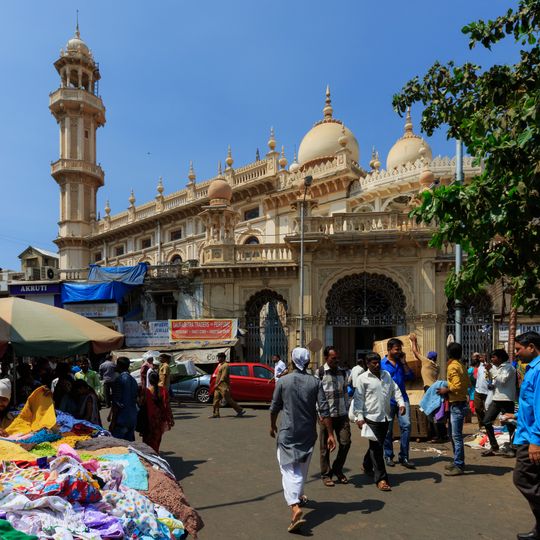
Jama Masjid in Mumbai is a two-storey quadrangular mosque of brick and stone in the Indo-Islamic style, built over a spring-fed tank. Sixteen black stone arches rise from the tank to support the structure, whose upper storey rests on five rows of wooden pillars. A tall slender tower with a domed top stands at the left of the arcaded facade, and bulbous domes, the central one largest, line the roofline.
A Konkani Muslim merchant trading with Goa and Kozhikode allowed a mosque to be built on his garden tank around 1775, on condition the tank was kept. Neighbour objections delayed work until 1778, and Governor Philip Meadows Taylor later ruled for the mosque authorities. It was completed in 1217 AH (1802/03 CE), and a top floor was added in 1814 with support from merchant Mohammad Ali Roghay.
The mosque follows the Shafie madhab and is managed by Konkani Muslims, whose Jamat elects a board of eleven directors every three years under a 1897 High Court scheme. The tank, fed by springs, holds gold and silver fish and a few turtles, and is still used for wudu. A digitised library holds rare manuscripts from as early as the 1890s.
The mosque is located near Crawford Market and remains open from sunrise to sunset throughout the day. Visitors should wear appropriate attire and can arrange visits outside of prayer times when guided tours are available.
The mosque rests on sixteen black stone arches raised from the tank in 1874, built at a cost of Rs. 75,000. Above them, five rows of wooden pillars each hold a receptacle for sacred books. The tank below keeps about 3 metres of spring-fed water with gold and silver fish and a few turtles.
The community of curious travelers
AroundUs brings together thousands of curated places, local tips, and hidden gems, enriched daily by 92,861 contributors worldwide.