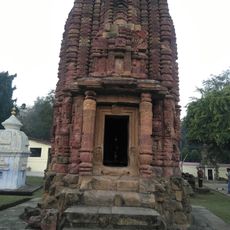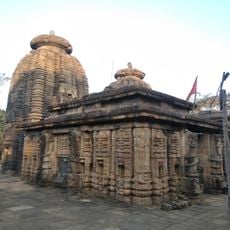
Leaning Temple of Huma, Hindu temple in Sambalpur, India.
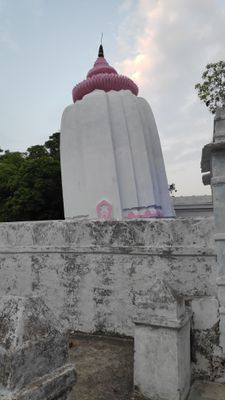
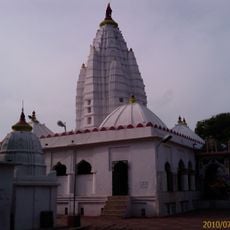
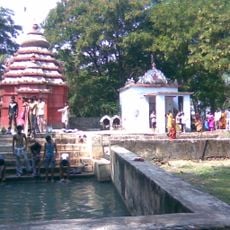
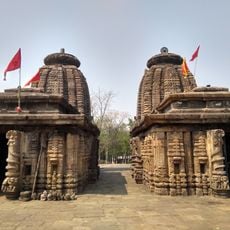
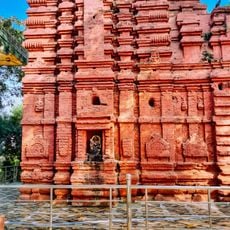
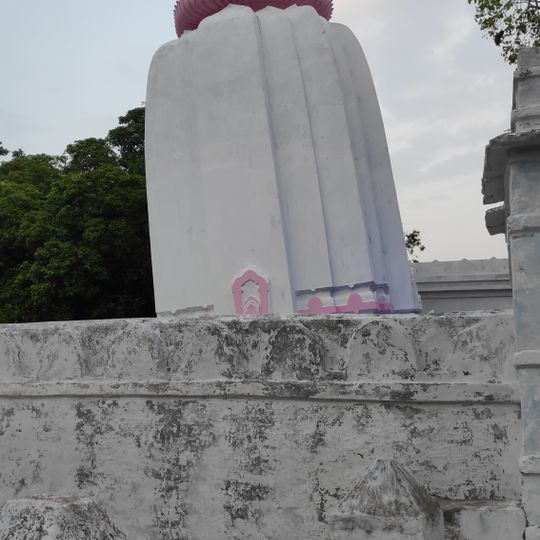
The Leaning Temple of Huma is a Hindu temple dedicated to Lord Bimaleshwar, standing on a rocky outcrop on the bank of the Mahanadi River. Its white, vertically ridged tower leans 13.8 degrees, yet the pinnacle remains perpendicular to the ground. A pink fluted element tops the structure, and a small pink arch is painted near the base. The Bhairavi Devi temple sits to the left and the Bhairo temple to the right.
Emperor Anangabhima Deva III of the Ganga dynasty is credited with building the temple. King Baliar Singh, the fifth Chauhan king of Sambalpur, rebuilt or renovated it between 1660 and 1690, and the surrounding shrines were added under King Ajit Singh (1766–1788). Odisha's Oriya sources instead attribute the founding to King Balaram Dev, which would place it around 1545–1560.
The temple is dedicated to Bimaleshwar, a form of Shiva, whose lingam is said to have emerged from the underground. A milkman is credited with starting the worship after a cow's milk was found flowing onto the lingam. Each March on Shivratri a fair is held at the foothill, drawing crowds that include foreign visitors.
The temple stands on a rocky outcrop on the bank of the Mahanadi in Huma, 23 km south of Sambalpur. Behind the shrine, steps lead down to the river, where boats can be taken to the Shyamakali shrine at Kunder Kuda. The annual fair is held at the foothill on Shivratri in March.
The Kudo fish, a slightly reddish species resembling aquarium carp, gather at the river ghat beside the temple and are fed by visitors. Legend holds that anyone who catches one turns to stone; a stone statue at the temple shows a woman cutting a Kudo fish, said to have suffered that curse.
The community of curious travelers
AroundUs brings together thousands of curated places, local tips, and hidden gems, enriched daily by 93,849 contributors worldwide.