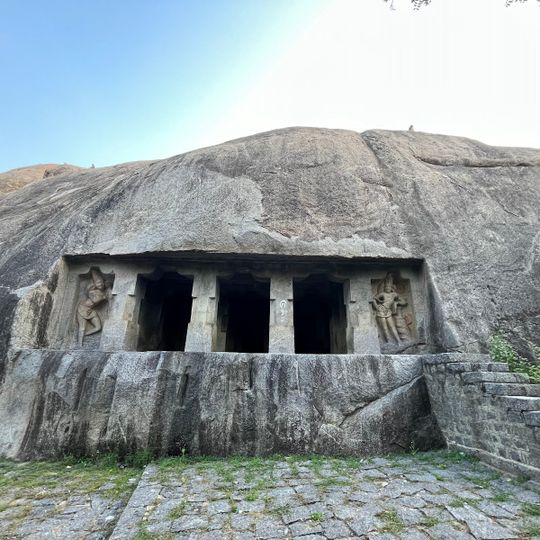
Mandagapattu Tirumurti Temple, Hindu temple in Mandagapattu, Tamil Nadu, India
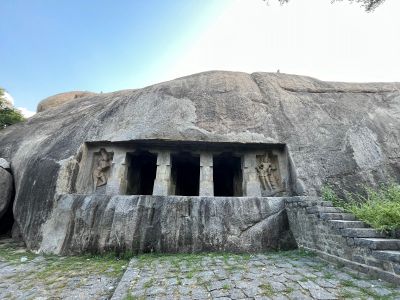
Mandagapattu Tirumurti Temple is a rock-cut cave temple carved into the northern face of a large rock overlooking an irrigation tank west of Mandagapattu village. Its facade is cut deep into the rock and has two pillars and two pilasters, with recesses for dvarapalas on either side. Behind the facade, a mukha-mandapa with a slightly lower floor leads to an ardha-mandapa, separated by rows of square pillars with octagonal kattu; the ceiling is plain.
Mahendravarman I, who ruled from about 590 to 630 CE, had the cave cut on the north face of a rock above the village tank; it is the first of his series of rock-cut caves and the oldest dated stone shrine found in Tamil Nadu. His Sanskrit inscription in Grantha script calls the shrine Lakshitayatna and the king Vichitrachitta, and states it was excavated without brick, timber, metal or mortar.
The temple is dedicated to the Trimurti — Brahma, Shiva and Vishnu — which sets it apart from most Pallava caves, which honour only Vishnu or Shiva. The Tamil source records three separate shrines for the three gods, but no images survive in them today. Mahendravarman I called the shrine Lakshitayatna, "the temple of Lakshita", in his inscriptions.
The cave lies 19 km from Viluppuram and 17 km from Senji; no bus runs from the main road to the cave, so the last kilometre is on foot. The rock face overlooks an irrigation tank west of Mandagapattu village.
The Sanskrit inscription in Grantha script records that Mahendravarman I, calling himself Vichitrachitta ("curious-minded"), excavated the shrine without brick, timber, metal or mortar. It names the temple Lakshitayatna, "the temple of Lakshita", and similar inscriptions appear at the Pallavaram and Tiruchirappalli cave temples.
The community of curious travelers
AroundUs brings together thousands of curated places, local tips, and hidden gems, enriched daily by 92,727 contributors worldwide.