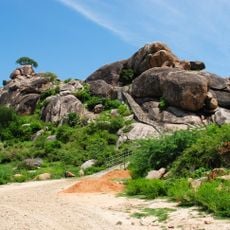
Talagirisvara Temple, Hindu cave temple in Panamalai, India
Talagirisvara Temple stands on a small hillock above Panamalai lake in Viluppuram district. It is a structural Pallava temple, not a cave: its east-facing garbhagriha holds a Dharalingam and a Somaskanda panel on the rear wall, with an ardhamandapam whose walls show Brahma with Saraswati and Vishnu with Lakshmi. Three-tiered vimana; squatting-lion pillars.
The temple was built in the 7th century during the Pallava dynasty, when King Narasimhavarman II commissioned several major religious structures across the region. This era shaped the artistic development of Hindu architecture in South India significantly.
The name Talagirisvara links the god to the palmyra palm, called tal in Tamil, which gives the village its name Panamalai. On the walls of the Ardhamandapam, panels show Brahma with Saraswati on one side and Vishnu with Lakshmi on the other. The northern sub-shrine keeps a damaged 7th-century painting of Shiva as Nataraja, the earliest known depiction of the dancing form, with Parvati painted on the opposite wall.
The temple stands on a small hillock above Panamalai lake, reached by a climb; the shrine faces east, so morning light falls on the entrance. Panamalai lies on the road from Viluppuram to Senji (Gingee), about 23 km from Senji. The Ardhamandapam and the northern sub-shrine holding the murals are the parts to look for once inside.
The paintings in the northern sub-shrine are badly damaged: Shiva as Nataraja survives on the left wall, dancing with his right foot on the ground and left knee bent, in the sandhya pose. Opposite, Parvati stands on one leg leaning against the wall, under a red umbrella, wearing a yellow crown, earrings, a red tilaka and a red sari with small flowers to the ankles, her feet in anklets.
The community of curious travelers
AroundUs brings together thousands of curated places, local tips, and hidden gems, enriched daily by 93,519 contributors worldwide.