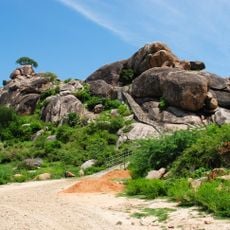
Gingee Fort, Monument of National Importance in Viluppuram district, India.
Gingee Fort is a fortress on three hilltops in Tamil Nadu connected by thick stone walls. The complex contains palaces, watchtowers, cisterns, and staircases carved into the rock that lead through steep paths between the separate summits.
The first fortification appeared in the 9th century under the Chola dynasty and controlled trade routes across southern India. Later the Nayakas in the 16th century expanded the walls and structures before Maratha and then British forces took over the stronghold.
The name Gingee derives from Senji, the site of a Kadava chieftain titled Senjiyar Kon mentioned in Ottakoothar's Moovarula around 1123 AD. The fort's presiding goddess is Chenjiamman, honoured in a temple within the complex. Tamil ballads and street plays retell the story of Raja Tej Singh, known as Thesingu Raasan, who revolted against the Nawab of Arcot and died in battle.
The climb to the summits follows steep stairs and footpaths that can be tiring in the heat, so visiting in the early morning hours works best. Sturdy shoes are necessary because many paths are uneven and cross rocky terrain.
The fort's name changed with each ruler: the Bijapur sultans called it Badshabad, the Marathas Chandry or Chindy, and the Mughals renamed it Nusratgadh in 1698 after commander Zulfiqar Khan Nusrat Jung. The English and French spellings Gingee and Jinji derive from these.
The community of curious travelers
AroundUs brings together thousands of curated places, local tips, and hidden gems, enriched daily by 92,672 contributors worldwide.