Parijaat tree, Kintoor, Heritage tree in Kintoor, India
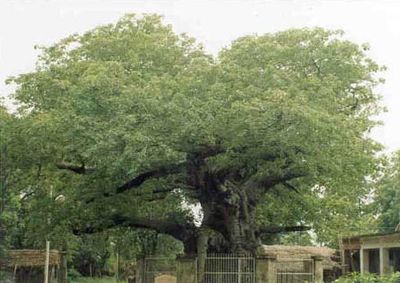
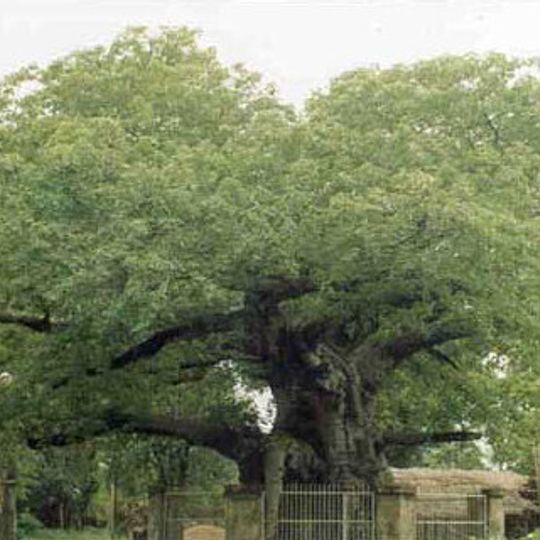
The Parijaat tree at Kintoor is an ancient specimen in Uttar Pradesh that produces white flowers at night which fall to the ground by sunrise. It reaches about 45 feet (14 meters) in height with a spread of roughly 50 feet (15 meters) and forms a wide canopy with dense foliage over a flat surrounding area.
Radiocarbon dating of the tree's oldest samples in 2019 gave 793±37 BP, a calibrated age of about 775±25 years. Local tradition holds the tree to be around 1,000 years old. Legends trace its planting to Arjun, who brought it from heaven for his mother Kunti, or to Krishna, who took it from Indra's garden for Satyabhama. The baobab genus is native to sub-Saharan Africa, so how it reached Kintoor is unexplained.
Local belief holds that the tree grew from the ashes of Kunti, mother of the Pandavas, and that Arjuna brought it from heaven so she could crown Shiva with its flowers. Another legend credits Krishna with bringing it for Satyabhama or Rukmini. Newly-weds come for blessings, and a fair is held every Tuesday. The Harivansh Puraan calls it a Kalpavriksha, a wish-bearing tree otherwise found only in heaven.
The white flowers must not be picked directly from the branches, so visitors collect them from the ground, especially in the early morning hours after the nightly bloom has fallen. The best time to visit is during the flowering season when fallen petals become visible around the trunk and the air carries a light fragrance.
The tree is a baobab, a species native to sub-Saharan Africa, which makes its survival in fertile Indian soil a rarity. Its age was long undetermined, and radiocarbon dating of the oldest samples in 2019 gave 793±37 BP, or about 775±25 calendar years. Local tradition puts its age at roughly 1,000 years.
The community of curious travelers
AroundUs brings together thousands of curated places, local tips, and hidden gems, enriched daily by 92,749 contributors worldwide.