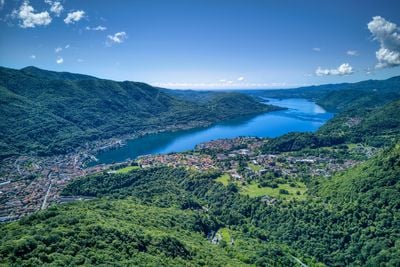
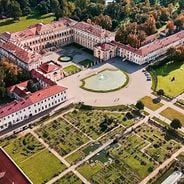
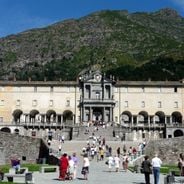
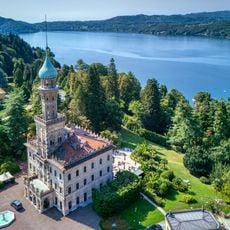
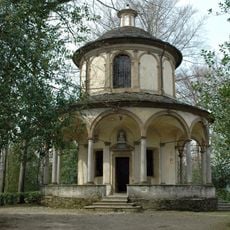
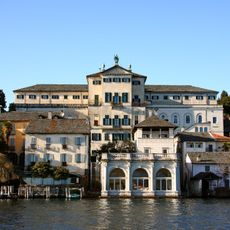
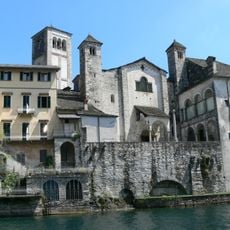
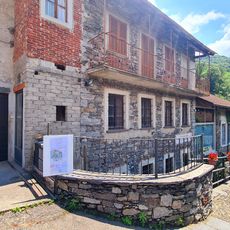
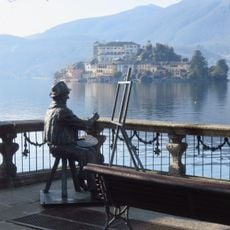
Lake Orta, Alpine lake in Piedmont, Italy.
Lake Orta is a north–south glacial lake in Piedmont, 13.4 km long and 2.5 km wide, with a maximum depth of 143 m. Its bed and shores consist mainly of gneiss, mica schist and granite. In the middle of the water lies the inhabited Isola San Giulio, 275 m long and 143 m wide, densely built with a medieval basilica, a convent and a bell tower.
Settlements on the lake date to the Neolithic, attested by pottery of the square-mouthed vase culture found on San Giulio island; during the Iron Age the shores were inhabited by Golasecca-culture Celts. In 1219 the Riviera di San Giulio became a bishop's fief, made an imperial county in 1311. Sovereign rights passed to the House of Savoy in 1767, formally renounced by the last prince-bishop in 1817.
The lake was long called Lago di San Giulio after the Greek deacon Julius, who lived on the island at the end of the 4th century and built a small church there. The island holds the Basilica di San Giulio, a medieval church, the Mater Ecclesiae convent and a bell tower. Milanese call the lake Cenerentola, Cinderella, because tourists pass it by for the larger lakes.
Regular ferry services connect the lakeside towns of Orta San Giulio, Omegna, and Pella, providing transportation for residents and visitors throughout the day. The waterfront promenades are mostly level and easy to explore on foot, while some paths leading to higher viewpoints become narrower and steeper.
The Nigoglia, the lake's only outflow, leaves at Omegna and runs north before joining the Strona, a course rare in the Alps. A moraine at the south end blocks any southern drainage. Because of this, the lake is also called Cenerentola (Cinderella) in Milan, as tourists overlook it for the larger lakes.
The community of curious travelers
AroundUs brings together thousands of curated places, local tips, and hidden gems, enriched daily by 92,886 contributors worldwide.