Palazzo Farnese, Renaissance palace in Regola district, Rome, Italy.
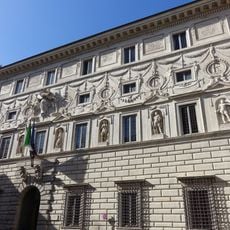
Palazzo Farnese rises over three floors with symmetrical windows, a central portal, and a stone facade reaching 29 meters in height in the Regola neighborhood. The interior rooms are arranged around a rectangular courtyard surrounded by arcades.
Cardinal Alessandro Farnese bought the site's older buildings between 1495 and 1512, and Antonio da Sangallo the Younger designed the palace, begun in 1514. Work stopped during the 1527 Sack of Rome and resumed in 1541 after Farnese became Pope Paul III, when the piazza was created. After Sangallo died in 1546, Michelangelo supplied the top cornice and the balcony with the papal coat of arms; Giacomo della Porta finished the Tiber-side rear in 1589.
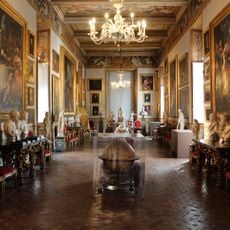
The Galleria Farnese, on the piano nobile rather than the top floor, holds Annibale Carracci's ceiling fresco The Loves of the Gods, painted 1597–1608 with his brother Agostino. Its framed quadri riportati, drawing on Raphael's Loggia of Psyche and Michelangelo's Sistine ceiling, mark the start of Roman High Baroque and Classicism. The palace also houses the École française de Rome library since 1875.
The building serves as the French Embassy in Italy since 1936 and is accessible only through guided tours that must be booked in advance. Visits cover selected rooms and the courtyard, with limited opening times.
The two granite basins now used as fountains in Piazza Farnese, not in the courtyard, come from the Baths of Caracalla and were adapted in the 16th century. The palace's rear facade toward the Tiber, finished in 1589, was meant to link by a bridge to the Farnesina, bought in 1580; the bridge was never built.
The community of curious travelers
AroundUs brings together thousands of curated places, local tips, and hidden gems, enriched daily by 93,371 contributors worldwide.