Basilica of Superga, Catholic church building in Turin, Italy
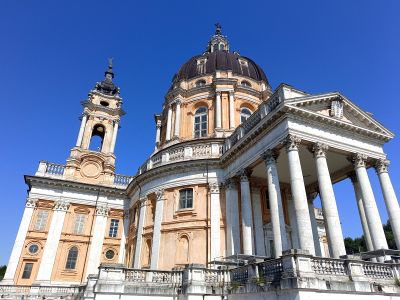
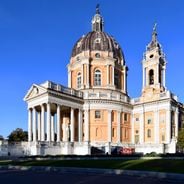
The Basilica of Superga is a Catholic basilica on the hill of Superga, 672 metres above sea level northeast of Turin. Its peach-orange walls with white stone trim carry a ribbed dome topped by a lantern, a tall bell tower with a clock face, and a white portico of many columns; white statues stand along the base. Inside, grey fluted columns with reddish marble panels line the nave, and the floor is paved in dark and light stone diamonds with circular medallions.
On 2 September 1706 Victor Amadeus II and Prince Eugene of Savoy climbed the hill and vowed to build a church to the Virgin Mary if Turin were freed. After the victory of 7 September, the duke entrusted the design to Filippo Juvarra in 1711; work began on 20 July 1717 and the temple was inaugurated on 1 November 1731 under Charles Emmanuel III. The crypt holds the tombs of the House of Savoy.
The name Superga is traced to a Lombard woman named Saroperga, said to have owned the woods on the hill; a Germanic form, Serrapergia, is also proposed, and both remain unproven. The chapel of the vow keeps the statue of the Virgin before which Victor Amadeus II knelt in 1706, and the royal crypt holds most members of the House of Savoy, including Charles Albert.
Access is via a rack railway that climbs the slope from the city outskirts, passing several stops before reaching the esplanade. On clear days the climb to the viewing platform under the dome is worthwhile for the panoramic view, while fog can severely limit visibility.
A side area commemorates the air crash of 1949 in which the entire team of football club Torino died when their plane hit the rear wall of the hill in thick fog. A small memorial with photographs and flowers marks the impact site and still draws supporters today.
The community of curious travelers
AroundUs brings together thousands of curated places, local tips, and hidden gems, enriched daily by 92,791 contributors worldwide.