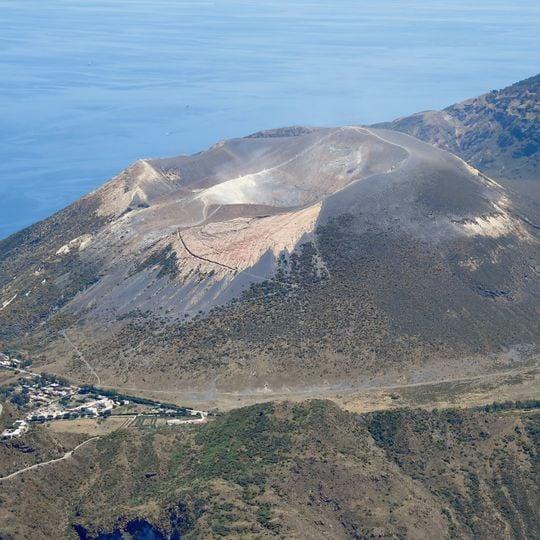
Vulcano, Active volcano in the Lipari archipelago, Italy
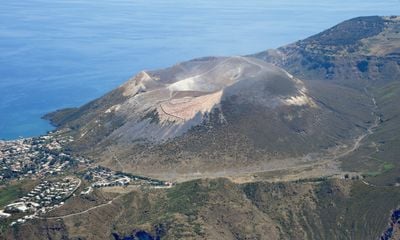
Vulcano is a complex stratovolcano on the island of the same name in the Aeolian archipelago. Its main cone, La Fossa, rises to 386 m beside Porto Levante and holds a crater about 500 m across; the upper slopes are bare grey and pale tan, cut by gullies, with a reddish-brown and pale rock patch on the left flank. A pale track crosses the left side, and a road runs along the base past a small cluster of buildings.
The Fossa crater was already active in antiquity, as recorded by Thucydides in the 5th century BC, when eruptions were heard as far as Sicily. Vulcanello emerged from the sea in 183 BC as a separate islet. Activity resumed at the Gran Cratere between 1727 and 1739, with ash falling on Lipari, Salina, Stromboli and the Sicilian coast, and the last eruption ran from 1888 to 1890, documented by seismologist Giuseppe Mercalli.
The name of the island and mountain gave the word for volcano to most European languages, through the Roman god of fire, Vulcan, who was said to live here. On the beach at Porto Levante, water and mud are warmed by sulfur dioxide from the weaker fumaroles; these mud baths have long been credited with benefiting the skin.
The island is accessible by regular ferry services connecting it to other Aeolian islands and mainland Sicily, with departures increasing during the summer season. Visitors should wear sturdy shoes since the ground is uneven and partly slippery.
The name of this mountain and its island gave the word "volcano" to most European languages, from the Roman god of fire, Vulcan, who was said to live here. The Fossa cone's explosive eruptions, documented by Giuseppe Mercalli in 1888–1890, gave geologists the term "Vulcanian eruption".
The community of curious travelers
AroundUs brings together thousands of curated places, local tips, and hidden gems, enriched daily by 94,661 contributors worldwide.