Ponte della Libertà, Road and rail bridge in Venice, Italy
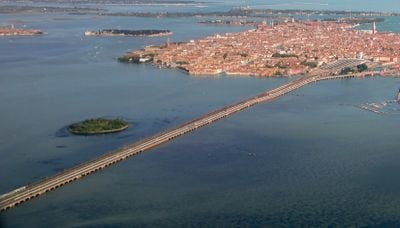
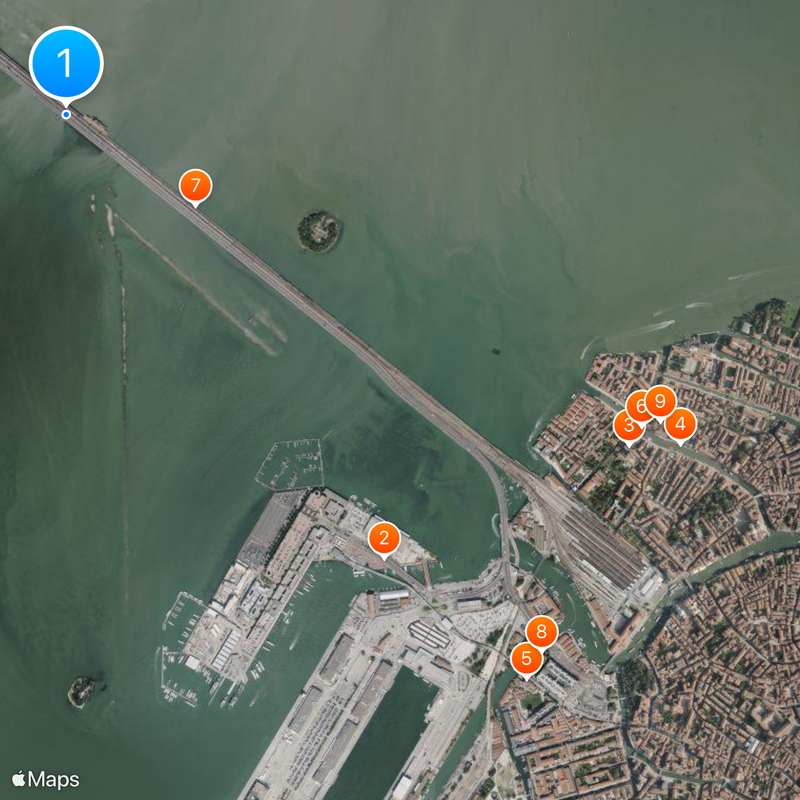
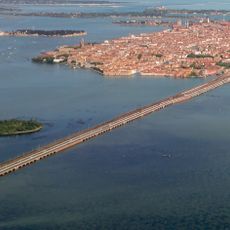
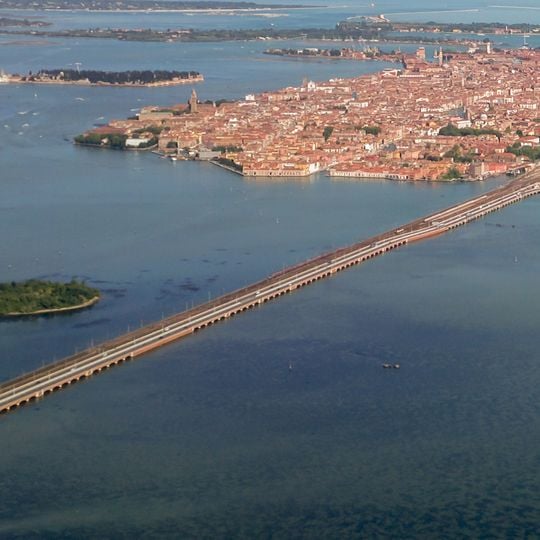
Ponte della Libertà is a road and rail bridge in Venice built from concrete, brick, and Istrian stone, stretching for 3850 meters across the lagoon. The construction connects the mainland district of Mestre with Piazzale Roma at the edge of the historic old town.
The railway viaduct, the "gran ponte della laguna veneta", was inaugurated on 11 January 1846 as part of the Ferdinandea Milan-Venice railway; its tracks were doubled from two to four in the 1970s. The road bridge, designed by Eugenio Miozzi and built in 18 months in reinforced concrete and stone, opened on 25 April 1933 as Ponte Littorio, inaugurated by Prince Umberto of Savoy with Benito Mussolini present. It was renamed Ponte della Libertà in 1946, after the war and the fall of the Fascist dictatorship.
The name dates from 1946, when Italy removed fascist references from public places after the war; the bridge had been the Ponte Littorio since 1933. Its new name also echoes 25 April, Italy's Liberation Day, which Venice already celebrated as the feast of Saint Mark. The road bridge ends at Piazzale Roma, where cars stop and the historic centre continues on foot and by boat.
The roadway offers two lanes in each direction along with railway tracks that run separately. Pedestrians and cyclists use dedicated paths along the construction.
The railway viaduct alongside was inaugurated on 11 January 1846, after 75,000 driven piles and 222 masonry arches were completed in October 1845. Its first test train ran on 4 January 1846, and the first service train left Santa Lucia on 14 January. In June 1849 the bridge was the site of fighting at the Sant'Antonio battery, remembered by a monument with two period cannons still in place.
The community of curious travelers
AroundUs brings together thousands of curated places, local tips, and hidden gems, enriched daily by 94,646 contributors worldwide.