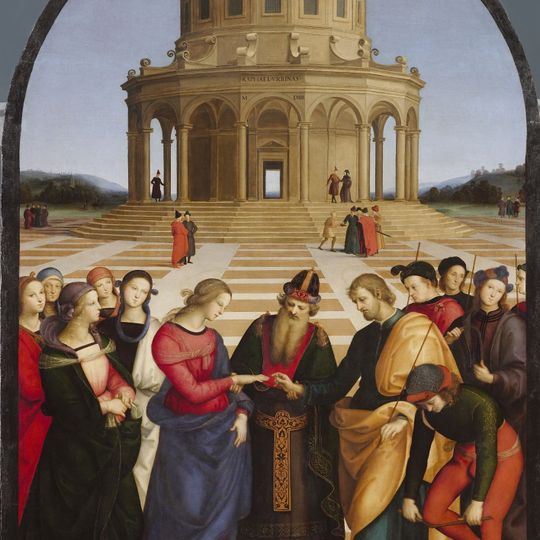
The Marriage of the Virgin, Renaissance painting in Pinacoteca di Brera, Milan, Italy.
The Marriage of the Virgin is an oil painting on panel, 170 by 117 cm, in the Pinacoteca di Brera in Milan. In the foreground a priest joins the hands of Mary and Joseph, with women behind her and men behind him on a paved slab. Behind them a round, domed temple with a lower ring of arched colonnades stands at the top of a flight of steps; its frieze reads "RAPHAEL VRBINAS" and "M. DIII".
Raphael created the work in 1504 for the church of San Francesco in Città di Castello before it was later moved to Milan. The piece was made at a time when the painter began developing independent compositions and moving away from his teachers.
The suitors' flowering rods come from the apocryphal gospels: Mary grew up in the Temple of Jerusalem, and each suitor received a dry branch, with only Joseph's flowering. In the painting one rejected suitor breaks his staff over his knee, a gesture Vasari-era viewers read as rancour, though his face stays composed.
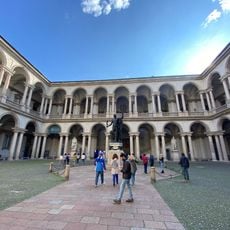
The painting hangs in one of the main rooms of the gallery and can be viewed well from several sides. Visitors can step close to examine the details in the faces and clothing of the figures.
One of the young men in the foreground breaks a staff over his knee, a detail from the legend that shows the moment when the rejected suitors acknowledge their defeat. The gesture is often overlooked, though it plays an important role in the narrative.
The community of curious travelers
AroundUs brings together thousands of curated places, local tips, and hidden gems, enriched daily by 95,353 contributors worldwide.