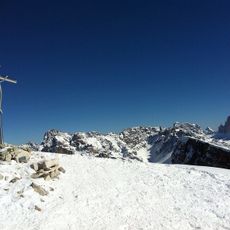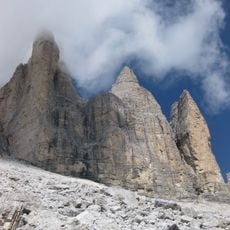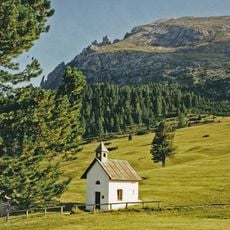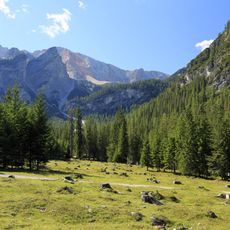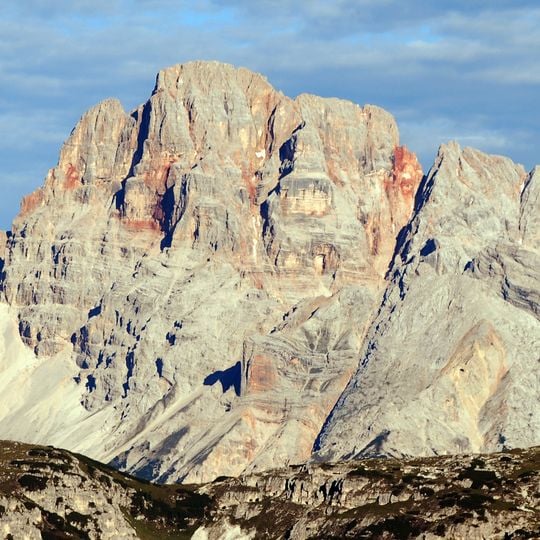
Hohe Gaisl, Mountain summit in Dolomites, Italy.
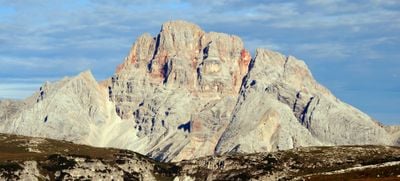
Hohe Gaisl, also known as Croda Rossa d'Ampezzo, is a mountain summit in the Dolomites that rises to 3,146 meters and features distinctive red limestone walls. The peak stands between Val di Braies and Val di Landro, forming a striking geological formation in the Alpine landscape.
The first recorded attempt was in 1865, when Paul Grohmann with Angelo Pizzo and Fulgentio Dimai reached only a pre-summit. The main summit was first climbed on 20 June 1870 by Whitwell with the guides Santo Siorpaes and Christian Lauener, via the west gully. The name Hoher Geysel appears in a 1501 border description of the Welsberg court.
The mountain carries three different names across the region: Hohe Gaisl in German, Croda Rossa d'Ampezzo in Italian, and Crep Checio in Ladin. This multilingual naming reflects the diverse local communities that share these Alpine slopes.
The easiest access is from the east, from the Gemärkpass and the Plätzwiese plateau; from Ponticello in Val di Braies the climb is harder. Only two normal routes exist, the Grohmann on the west and the Innerkofler on the north-east from Prato Piazza, and the friable rock makes both demanding. The Pia Helbig Dall'Oglio bivouac at 2,253 m was demolished and has not existed since summer 2013.
From Prato Piazza a large hole pierced through the rock, the Occhio di Dio, can be seen; in Ampezzo it is called Busc de ra Costa del Pin. The massif's red colour comes from Jurassic limestones and Cretaceous marls overlying the main dolomite. On 19 August 2016 a rock mass about 500,000–700,000 cubic metres in volume collapsed from the Piccola Croda Rossa.
The community of curious travelers
AroundUs brings together thousands of curated places, local tips, and hidden gems, enriched daily by 93,863 contributors worldwide.