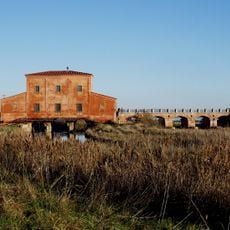
Abbey of San Pancrazio al Fango, Medieval abbey ruins in Diaccia Botrona Nature Reserve, Italy
The Abbey of San Pancrazio al Fango consists of medieval church ruins featuring a semicircular apse base and partially standing walls scattered across the site. The remains reveal the original structure of a single-nave church with a transept and various wall sections still visible.
The abbey was founded between the 8th and 9th centuries and eventually lost its independence when transferred to Sestinga Abbey in the late 12th century. This change in ownership marked the beginning of its decline as a separate religious institution.
The name Isola Clodia comes from the Roman villa that Clodius had built here around the mid-1st century BC, a site Cicero mentions in his speech Pro Milone. The abbey later passed to the Guglielmite Order, based at the hermitage of San Guglielmo di Malavalle in the Castiglione hills. Visitors can still see the sandstone filaretto masonry with bands of travertine blocks.
The ruins are located in a remote area between Grosseto and Castiglione della Pescaia and require advance planning before visiting. Wear appropriate gear for variable weather and bring means of orientation, as the site is accessible but not easily marked.
The island site takes its name, Isola Clodia, from Clodius, who built a Roman villa here around the mid-1st century BC; Cicero mentions the villa in his speech Pro Milone. Parts of that villa were later absorbed into the abbey walls, while other sections lie under the soil and appear only in aerial photographs.
The community of curious travelers
AroundUs brings together thousands of curated places, local tips, and hidden gems, enriched daily by 93,586 contributors worldwide.