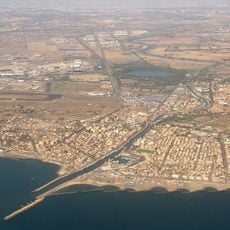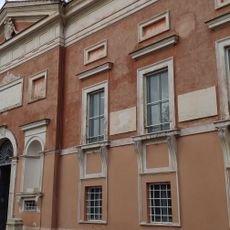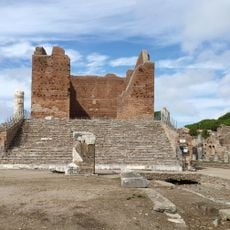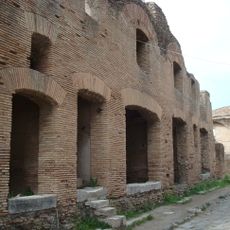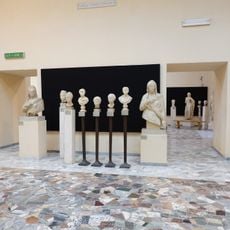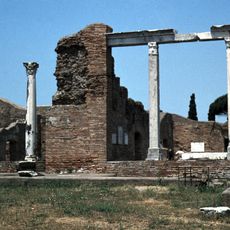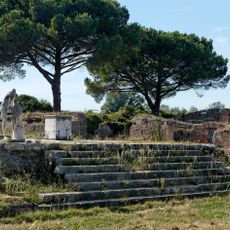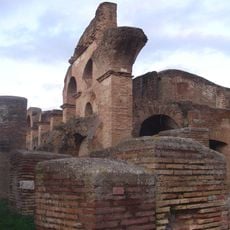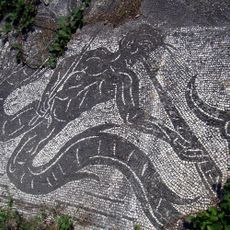
Museo delle navi romane, Archaeological museum in Fiumicino, Italy.
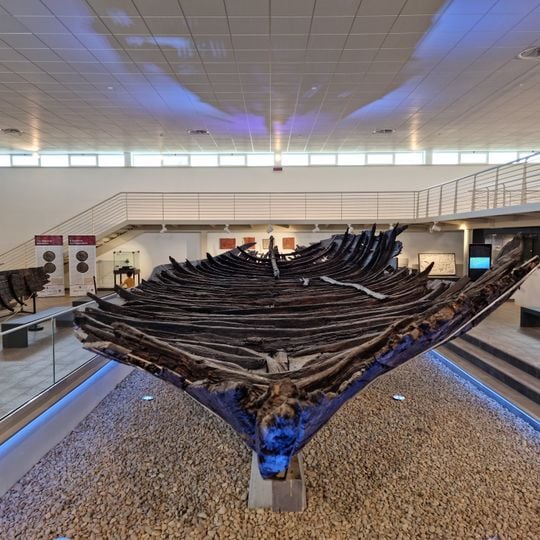
The Museo delle Navi Romane displays five complete shipwrecks: three caudicariae (Fiumicino 1, 2 and 3), the small sailing ship Fiumicino 4 and the navis vivaria Fiumicino 5, plus two hull-side fragments. The wooden hulls, built shell-first with mortise-and-tenon joints, show local oak, pine, cypress and juniper timbers.
The first wreck, Fiumicino 2, was found in 1958 during work on Rome-Fiumicino Airport, followed by Fiumicino 1, 3 and 5 between 1959 and 1961. Engineer Otello Testaguzza and archaeologist Valnea Santa Maria Scrinari had a wooden hangar built on the find site so the waterlogged hulls could be consolidated before the air damaged them. The hangar became a museum, inaugurated in 1979, closed in 2002 and reopened in October 2021.
The three caudicariae, Fiumicino 1, 2 and 3, were flat river barges of 17 × 5.5, 19 × 6.3 and 14 × 4.5 metres that lightened cargo from sea-going ships docking at Ostia and Porto. The small sailer Fiumicino 4 carried about 3.8 tonnes, and the fishing boat Fiumicino 5 kept its catch alive in a 300-litre tank. Such craft fell out of use between the late 4th and early 5th century.
The museum sits near the airport with access on weekdays and weekends except Mondays and public holidays. Guided tours are sometimes available and can help you understand the displays better.
One fishing boat features a central water tank system built to hold about 300 liters and keep caught fish alive during transport. This clever engineering reveals that Roman fishermen had ways to keep their catch fresh for market.
The community of curious travelers
AroundUs brings together thousands of curated places, local tips, and hidden gems, enriched daily by 92,641 contributors worldwide.