San Sebastiano, Renaissance church in Mantua, Italy
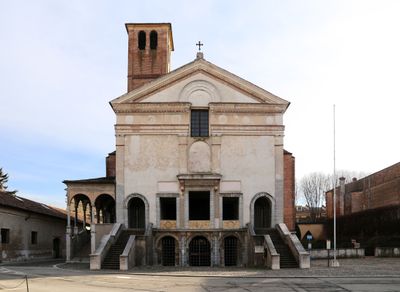
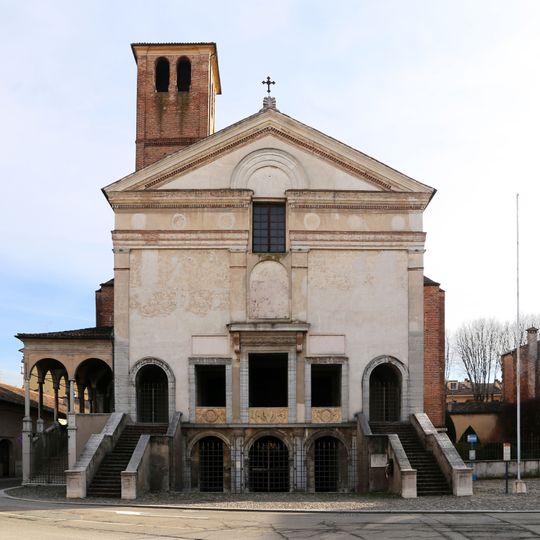
San Sebastiano is an Early Renaissance church in Mantua whose Greek-cross plan, with three identical apsed arms around a central cross-vaulted space, was begun by Leon Battista Alberti in 1460. The pale plastered facade has a triangular pediment and a central arched window breaking the entablature; two stone staircases with balustrades flank it, and a low arched portico extends to the left.
Begun around 1460 to designs by Leon Battista Alberti, the church was left partly finished in the mid-1470s after construction slowed and passed from his direction. Ludovico III Gonzaga's 1470 letter agrees to reduce the pilasters on the portico. Consecrated in 1529, it was restored in 1600 and again by 1926, when the two facade staircases were added and two windows turned into portals.
San Sebastiano was built as the Gonzaga family's mausoleum, with a ground-level crypt intended for their tombs. The church later became a memorial to the fallen of the Fatherland. Its name comes from Saint Sebastian, to whom the temple was dedicated.
The church is located in the center of Mantua and is reachable on foot from the city's main squares. The best approach is from the nearby street leading to Largo XXIV Maggio, which offers clear views of the building.
The church was not built as a traditional cathedral with a long nave, but instead follows an unusual Greek cross layout that experimented with ancient mathematical ideals. This choice shows how boldly early Renaissance architects approached breaking away from traditional religious building forms.
The community of curious travelers
AroundUs brings together thousands of curated places, local tips, and hidden gems, enriched daily by 92,837 contributors worldwide.