San Barnaba, Baroque church in Mantua, Italy.
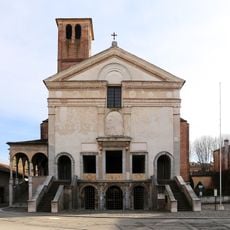
San Barnaba is a Roman Catholic church at the intersection of Via Giovanni Chiassi and Via Carlo Poma in Mantua. Its interior has a single nave with three side chapels and a deep apse. The facade was rebuilt in 1737 to a design by Antonio Bibiena. Among the paintings are Lorenzo Costa the Younger's Multiplication of the Loaves and Fishes (1582–1583) and Giuseppe Bazzani's Via Crucis.
A church dedicated to St Barnabas, the first bishop of Milan, stood on this site by 1263. In 1397 Francesco I Gonzaga entrusted it to the Servite Order, who built an adjoining convent. Giulio Romano was buried here in 1546; his tomb was desecrated and lost during the rebuilding completed in 1737 with a new facade by Antonio Bibiena. The convent was suppressed in 1797 and partly demolished in the early 1900s for the city prison.
The church is named after St Barnabas, the first bishop of Milan. Its artistic heritage is tied to the Servite Order, which held it from 1397: the altarpiece of the Effigy of St Filippo Benizzi, a Servite saint, by Giuseppe Orioli stands at the third altar on the left, and Bernardino Malpizzi painted the Madonna with Child and St Filippo Benizzi.
The church faces the small Piazza Bazzani at the corner of Via Giovanni Chiassi and Via Carlo Poma, a short walk from Mantua's historic centre. Enter from the piazza; the single nave leads straight to the deep apse, with the three side chapels opening off it. The 1737 facade by Antonio Bibiena is the landmark to look for when approaching.
The renowned Renaissance architect Giulio Romano, who shaped Mantua's identity, was buried here in 1546, though his tomb vanished during later reconstruction work. This connection to one of the city's most influential figures remains largely hidden from view today.
The community of curious travelers
AroundUs brings together thousands of curated places, local tips, and hidden gems, enriched daily by 93,182 contributors worldwide.