Palazzo del Te, Renaissance villa in Mantua, Italy
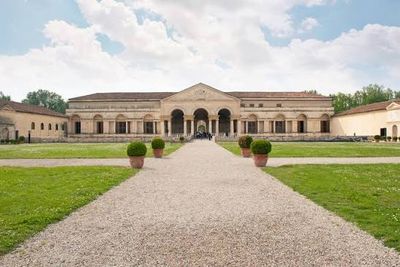
Palazzo del Te is a wide, low, single-storey Mannerist villa outside Mantua's walls, built as a square block around a square courtyard with four entrances. Its rusticated façades carry smooth Doric giant-order pilasters, and the main front is a loggia of three arches on paired columns mirrored in small fish ponds. The courtyard's marble columns are left almost rough, and a triglyph appears to slide down in the frieze.
Federico II Gonzaga chose the Isola del Te, site of the family stables built in 1502, for a leisure palace away from the Ducal Palace and his mother Isabella d'Este. Giulio Romano, a pupil of Raphael, raised the shell within eighteen months from 1524; plasterers, carvers and fresco painters then worked for ten years. In 1630, during the War of the Mantuan Succession, 36,000 Landsknecht mercenaries sacked Mantua and looted the palace.
The name comes from Tejeto island, where Gonzaga horses once grazed before the manor was built. Visitors today still see how the halls served for receptions and festivities, while wall paintings tell ancient stories.
The palace stands on the Isola del Te at the edge of the former marshes just outside Mantua's walls, a short walk or bicycle ride from the centre. The ground-floor piano nobile is slightly raised above the street to guard against Mincio floods, so expect a few steps at the entrances. The civic museum and the frescoed halls share the same visit.
The estate has no bedrooms, as it served only for festivities and receptions, not as a permanent residence. The duke used the property exclusively during the day for entertainment and returned to the city at night.
The community of curious travelers
AroundUs brings together thousands of curated places, local tips, and hidden gems, enriched daily by 92,784 contributors worldwide.