Basilica of San Pietro de Dom, Demolished early Christian basilica site in Brescia, Italy
The Basilica of San Pietro de Dom stood on the east side of Piazza del Duomo in Brescia, a small building hemmed in by houses to the north on today's Via Querini and to the east on Via Mazzini. Its floor lay lower than the square, a sign of its antiquity, and three naves were divided by two colonnades of fourteen columns each, all spolia of differing height, diameter, material and colour, most of them iron-coloured dark Egyptian marble. The 1588 Estimo miniature shows a stepped facade with a central body rising above two lower aisles, a rose window and the entrance portal below.
Baldassare Zamboni's chronicle, written at the end of the 16th century, dates the basilica's construction to the 7th century. A fire in 800 weakened its walls, and another in 1096 devastated the piazza and the Porta Bruciata quarter, which took its name from that event; earthquakes followed in 1117 and 1142. Between 1571 and 1581 Giovanni Maria Piantavigna raised the floor to the level of the square, opened windows and built a new roof with a false ceiling. Structurally unstable, it was demolished within about twenty years to make way for the New Cathedral.
The name 'de Dom' comes from the episcopal domus, the bishop's residence with the urban clergy, still identifiable in the palazzo vescovile on Via Mazzini behind the cathedrals. San Pietro was Brescia's summer cathedral, paired with the adjacent Santa Maria Maggiore de Dom as winter cathedral. The basilica was known for its music: it had an organ and a complete orchestra, and its monks patronised the viol-maker Gasparo da Salò.
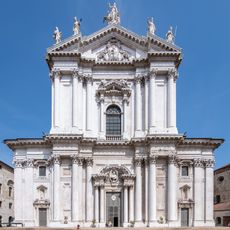
Nothing of the basilica remains in place: the site is now occupied by the Duomo Nuovo, begun after the demolition. Six of its dark Egyptian-marble columns, about five metres tall, were reused in the forecourt of Villa Mazzucchelli at Ciliverghe, two at the Broletto entrance on the piazza and two at the entrance of Santa Maria della Carità.
Of the basilica's fourteen dark Egyptian-marble columns, about five metres tall and smooth, several survived the demolition: two frame the Broletto entrance on the piazza, two stand at the entrance of Santa Maria della Carità, and six are in the forecourt of Villa Mazzucchelli at Ciliverghe. The church also kept an organ and a full orchestra, and its monks patronised the viol-maker Gasparo da Salò.
The community of curious travelers
AroundUs brings together thousands of curated places, local tips, and hidden gems, enriched daily by 92,789 contributors worldwide.