Torre del Pegol, Medieval defensive tower in Brescia, Italy
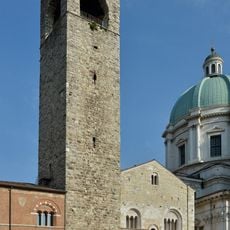
Torre del Pegol is a stone tower about 54 metres tall attached to the Palazzo Broletto on Piazza Paolo VI in Brescia. It has four visible levels: a large white Botticino stone base, a second level crossed by a narrow two-metre tunnel, and a third level within the old palace walls linked to the top by a helical staircase rebuilt in the 16th century by Dionisio Bolda.
The tower's date and origin are unknown, but 12th-century manuscripts mention it, and it withstood the 1222 earthquake of magnitude 6.05. In 1178 the Laubia lignorum, the city's first seat of government, was founded at its foot; in 1235 the bronze Campana Militum was hung to call the city troops. From 1434, under Venetian rule, the bell tower and bell were repeatedly rebuilt.
The tower's name recalls its role as the people's and market tower beside the Broletto. Its bells marked civic life: the Campana Militum, cast in 1235, called the city troops to arms, and during the Ten Days of Brescia in 1849 children rang the tower bells while adults fought on the barricades, as the poet Angelo Canossi recalled.
The tower stands on Piazza Paolo VI, attached to Palazzo Broletto, not on Corso Giuseppe Garibaldi. It reopened to visitors in 2007 after modern restoration work. Inside, a helicoidal staircase modified in the 16th century by Dionisio Bolda links the upper levels.
The tower's bell, the Campana Militum, was cast in 1235 to call Brescia's troops to arms. Under Venetian rule the original 800 kg bell was melted down and recast as four smaller bells, which still hang at the top of the tower.
The community of curious travelers
AroundUs brings together thousands of curated places, local tips, and hidden gems, enriched daily by 94,225 contributors worldwide.