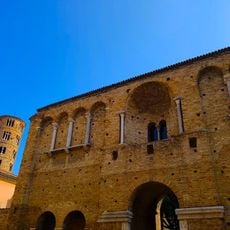
Basilica di Sant'Agata Maggiore, Early Christian basilica in Ravenna, Italy
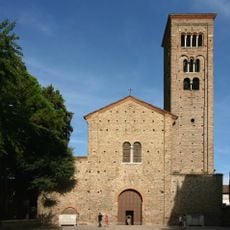
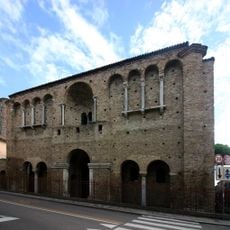
Basilica di Sant'Agata Maggiore is a fifth-century basilica in Ravenna whose brick facade, with four pilaster strips on the central section, results from the 1913-1918 restoration by Giuseppe Gerola. The central portal is preceded by a barrel-vaulted protiro taken from the former church of San Niccolò and installed in 1913. Inside, three naves are divided by two rows of ten reused columns of differing periods, and the central nave has an exposed truss ceiling from the 1980s.
The basilica was founded in the 5th century, probably under Bishop John I (477–494), with work continuing under Bishop Peter II (494–519), whose monogram is visible in the central nave. The apse was likely added in the following century under Bishop Agnellus (556–569), financed by the Ravenna banker Julianus Argentarius, who also funded San Vitale. The original floor lay about 2.5 metres below today's level.
The altar area with its sixth-century pluteus shows how early worshippers organized their sacred spaces. The simple design of the altar reflects religious practices when the community gathered here.
Visitors should plan around regular service schedules, which may affect access to the building. The best time to explore is outside these hours when the church opens for sightseeing.
The 1688 earthquake destroyed the apse mosaic; only fragments remain in the window intrados. The floor was raised 2.50 metres afterwards, and the bare apse was fitted with Baroque furnishings instead.
The community of curious travelers
AroundUs brings together thousands of curated places, local tips, and hidden gems, enriched daily by 93,144 contributors worldwide.