Castello di Gallipoli, Medieval fortress in Gallipoli, Italy.
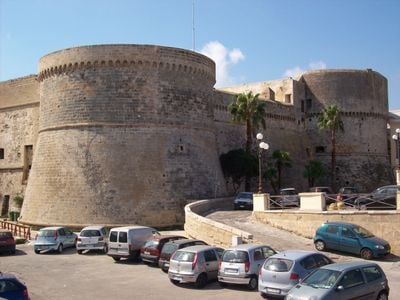
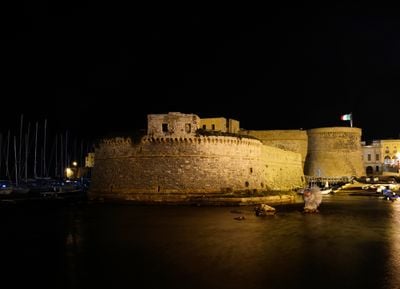
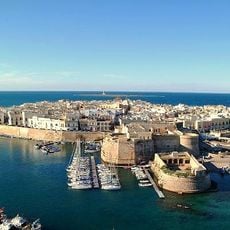
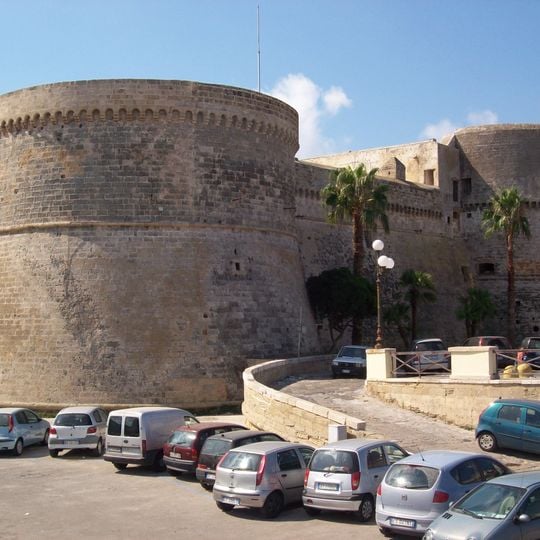
Castello di Gallipoli is a coastal fortress on a quadrangular plan with three round turrets and one polygonal tower, built of rough light-brown and grey stone at the eastern tip of the island of Gallipoli. A massive round bastion with a corbelled parapet rises above the water, and the walls are pierced by small rectangular openings. Inside are large halls with barrel and cross vaults, tunnels and walkways.
The structure originated in Roman times and was reshaped over centuries by Byzantines, Normans, Angevins, and Aragonese rulers. Each of these powers left their mark on the fortifications and overall design.
The Rivellino, the eastern outwork added in 1522, is named for its role as a defensive spur; its stone turret and wooden entrance still show the remains of a second bridge that once ran from near the church of Santa Cristina. Since reopening on 5 July 2014 the castle has hosted exhibitions, including a 2015 show by Michelangelo Pistoletto, who called it an "Ambasciata del Terzo Paradiso", and from summer 2015 the Premio Barocco.
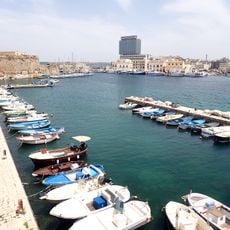
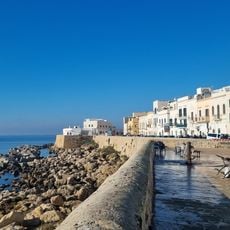
The visit runs through vaulted halls, tunnels and walkways, with stairs up to the towers and terraces. The moat was filled in between 1870 and 1879 and the fish market was built against the facade, so the seaward walls are best seen from the water or the harbour side. The castle reopened to the public on 5 July 2014.
The Rivellino is not a round tower but a curtain wall built in 1522 to defend the city entrance, designed by Francesco di Giorgio Martini for Alfonso II of Naples. In the 17th century it was cut off from the castle to add a square tower over the flag tower. Remains of a second bridge from near Santa Cristina are still visible beside its stone turret.
The community of curious travelers
AroundUs brings together thousands of curated places, local tips, and hidden gems, enriched daily by 94,572 contributors worldwide.