Castello di Monzambano, Medieval castle in Monzambano, Italy
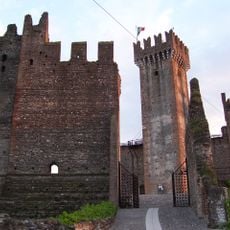
Castello di Monzambano is a stone fortification with polygonal walls and towers positioned strategically along its perimeter on the Morainic hills. The structure combines military defenses with internal spaces for residence, worship, and agriculture.
The castle dates to the 11th century, probably built by order of Matilda of Canossa to shelter the population from barbarian invasions. In the early 13th century it passed to the Scaligeri, who had defeated the Mantovans at Ponte Molino. The Visconti acquired it in 1391; in 1495 the Republic of Venice took Monzambano and held the castle until the end of the 18th century, after which the Napoleonic era returned the town to Mantua.
The Church of San Biagio sits within the walls alongside residential buildings and cultivated gardens, reflecting how the fortress functioned as a self-contained community. This mix of sacred, domestic, and agricultural spaces shows how people lived and worked together inside the fortification.
The castle stands on a height above the centre of Monzambano, and its walled circuit follows the irregular profile of two adjoining hills, so the visit involves walking along sloping ground between the towers and the perimeter walls. The small church of San Biagio is inside the walls.
The walls feature a multi-level walkway system and Guelph merlons that show medieval military design in the Mantovano region. This construction style reveals how fortifications were built during a specific period of conflict between regional powers.
The community of curious travelers
AroundUs brings together thousands of curated places, local tips, and hidden gems, enriched daily by 92,970 contributors worldwide.