Castello di Bruzolo, Medieval castle in Bruzolo, Italy.
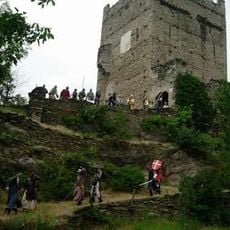
Castello di Bruzolo is a medieval fortress in Bruzolo with a double defensive wall, a massive entrance gate, and a horseshoe-shaped main building made of stone with three floors. The structure shows the military architecture needed to control the territory.
The fortress developed in the Middle Ages as a defensive installation and became an important negotiation site for European powers in the 1600s. An agreement between France and the Duchy of Savoy signed here in 1610 shaped European politics for years to come.
The toppioni are stone pillars 4–5 m high that once carried wooden pergolas for vines above the lanes around the castle; a row survives along via del Toppione east of the village. A 1610 letter of Duke Carlo Emanuele I already mentions them, and they resemble those of Settimo Vittone.
The castle is not open to visitors, so the interior cannot be seen. The medieval Porta Granda with its machicolation, the corner turrets and dovecote of the outer wall, and the two surviving cylindrical towers can be observed from the surrounding lanes and countryside.
The 1610 Treaty of Bruzolo was signed in the castle by Claude de Bullion and François de Bonne de Lesdiguières for Henry IV of France and Duke Charles Emmanuel I of Savoy. The duke's letter to his son describes receiving the French envoys at the "topia", the column-supported vine pergola at the entrance, whose pillars still stand.
The community of curious travelers
AroundUs brings together thousands of curated places, local tips, and hidden gems, enriched daily by 94,540 contributors worldwide.