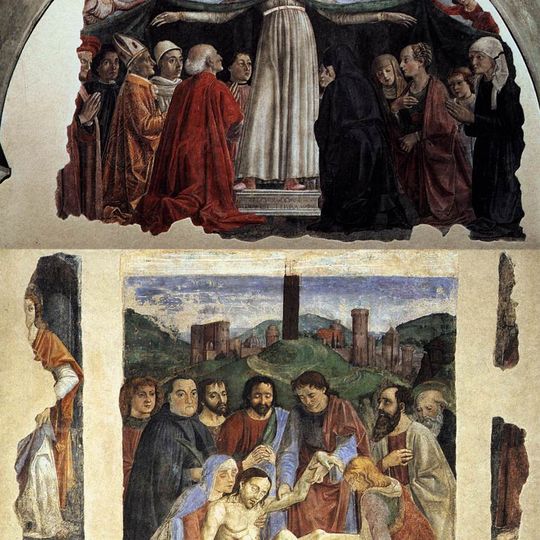
Madonna of Mercy and Lamentation, Renaissance fresco in Ognissanti Church, Florence, Italy
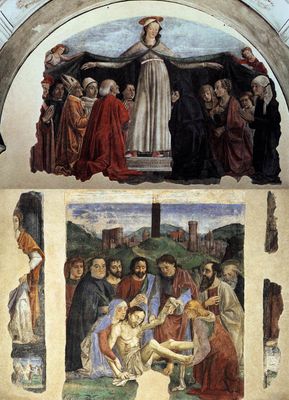
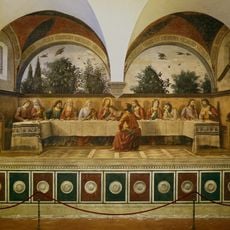
The Vespucci Chapel, the second niche on the right of the nave in Ognissanti, holds two frescoes by the young Domenico Ghirlandaio: below, the Lamentation, with the dead Christ held by Mary and the blond Magdalene before a walled city and the hill of Golgotha; above, the Madonna of Mercy, her wide cloak held by two angels over kneeling Vespucci portraits, her feet on a step inscribed MISERICORDIA DOMINI PLENA EST TERRA.
The Vespucci, a family of bankers allied with the Medici, had their funeral chapel built in Ognissanti between 1474 and 1479. The young Domenico Ghirlandaio, recently enrolled in the Compagnia di San Luca, painted the frescoes around 1476–77. In 1878 the frescoes were rediscovered beneath a layer of whitewash, which had caused severe damage to the borders.
The Latin inscription beneath Mary's feet reads "MISERICORDIA DOMINI PLENA EST TERRA", "the earth is full of the mercy of the Lord". The kneeling figures under her cloak are Vespucci family members, women on the right and men on the left, including the elderly Ser Amerigo in red, who died in 1472. Vasari identified the young man at Mary's left as the navigator Amerigo Vespucci.
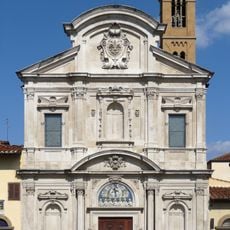
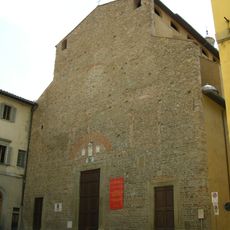
The chapel is the second niche on the right wall of the nave of Ognissanti church, near the entrance, so it is seen on foot while walking the nave. The frescoes were rediscovered in 1878 under a layer of whitewash, and their damaged edges mean the central panels are best read from directly in front of the niche.
The composition includes portraits of members of the Vespucci family, showing how Ghirlandaio integrated likenesses of living people into religious scenes. This practice was innovative for the time and allowed wealthy families to secure their presence in sacred works.
The community of curious travelers
AroundUs brings together thousands of curated places, local tips, and hidden gems, enriched daily by 92,612 contributors worldwide.