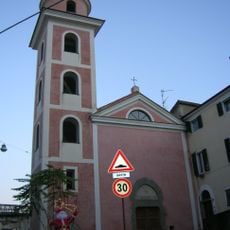
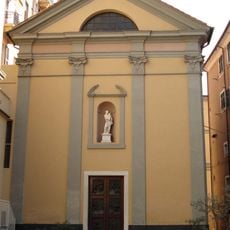
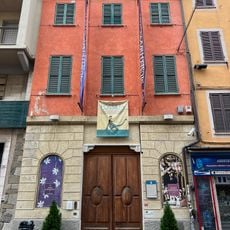
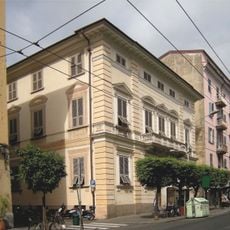
Nostra Signora della Salute, Catholic church and shrine in La Spezia, Italy.
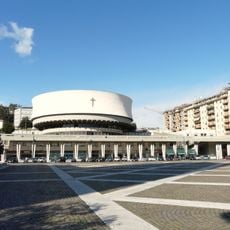
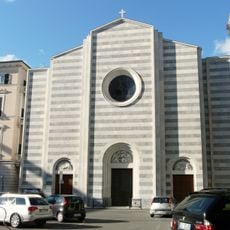
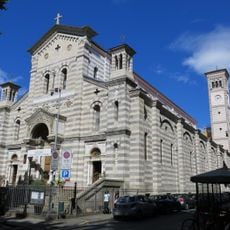
Nostra Signora della Salute is a Catholic parish church and shrine on Piazza Brin in the Umberto I district of La Spezia. It has a single vaulted nave with matronei flanking the presbytery, and two bell towers with neo-baroque domes completed in 1912. The high altar is a marble baroque piece of 1771; the venerated Madonna della Salute, an oil on canvas of unknown author, probably 16th-century, stands on a throne about eleven metres above the floor, framed by four columns of yellow Verona marble with Carrara marble sculpture.
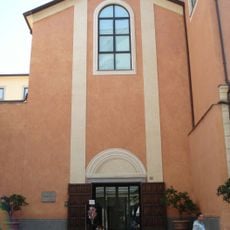
Construction began in 1887 as part of the new Umberto I popular quarter and was completed in 1900, though the two bell towers with neo-baroque domes were finished only in 1912. A plaque in the baptistery, placed in 1910 for the consecration by Bishop Giovanni Carli, records that the church was built at the wish of his predecessor Giacinto Rossi to a design by architect Maurizio Dufour. It inherited the name and devotion of the 16th-century Madonna della Scorza oratory, demolished after the railway station moved from Valdellora to its current site.
The name and devotion come from the 16th-century Madonna della Scorza oratory on today's Viale Ferrari, demolished when the station moved to Valdellora; some of its columns were reused in the former Hotel Terminus. The venerated painting, an oil on canvas of unknown author, was crowned in 1925 with gold diadems made by melting jewellery donated by parishioners.
The church stands on Piazza Brin in the Umberto I district of the historic centre, facing the Fontana delle Voci by Mirko Basaldella (1956). The interior is a single vaulted nave with matronei flanking the presbytery; the venerated Madonna della Salute hangs on a throne about eleven metres up, framed by four columns of yellow Verona marble. Look for the organ by Tamburini (opus 92, 1925) on the counter-façade.
The venerated painting of the Madonna della Salute has no known author or origin; it is thought to date from the 16th century. In 1925 parishioners donated jewels and ornaments that were melted down to make the gold diadems adorning the canvas. The holy water stoup near the entrance still shows marks of a serious act of vandalism in 1907.
The community of curious travelers
AroundUs brings together thousands of curated places, local tips, and hidden gems, enriched daily by 93,131 contributors worldwide.