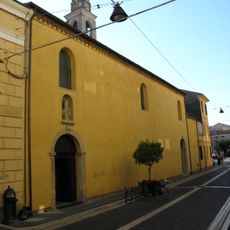
Santi Francesco e Giustina, Neoclassical church in Rovigo, Italy.
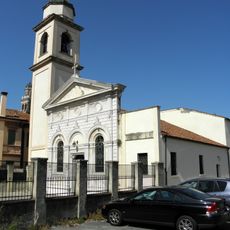
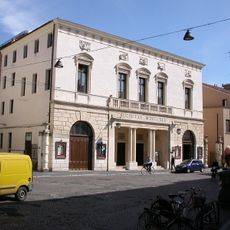
Santi Francesco e Giustina is a church in Rovigo with a Neoclassical facade built between 1853 and 1896, once adorned with five statues removed in the late 1960s. The 19th-century rebuilding absorbed the original Gothic structure into the current transept. Inside, the third altar on the left holds Tullio Lombardo's 1526 Pietà.
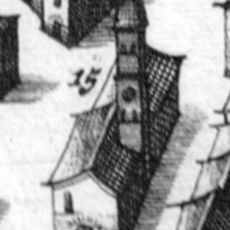
The first church of San Francesco was built between 1297 and 1300 in Gothic style, with a single nave and five apsidal chapels, attached to a Franciscan convent founded by the will of Obizzo II d'Este. A right nave with five communicating chapels was added in 1413, the bell tower in 1520 and the central apse was lengthened in 1533. Suppressed and desecrated on 27 September 1797 under Napoleon, it reopened in 1799 and became parish church on 11 April 1806, replacing Santa Giustina. A rebuilding begun on 13 May 1827 absorbed the old church into the present transept; the church was consecrated on 7 May 1837 and the facade built between 1853 and 1896.
The double dedication dates from 11 April 1806, when the church replaced the demolished Santa Giustina as parish seat and took both titles. The parish had asked for a baptismal font as early as 1603; it was only installed on 6 July 1914.
The church is located within the Roman Catholic Diocese of Adria-Rovigo and welcomes visitors during regular service times throughout the week. It is best to visit outside of main service hours if you wish to explore the interior at a relaxed pace.
The facade was built between 1853 and 1896 on today's churchyard and once carried five statues, removed in the late 1960s. The baptismal font was only installed on 6 July 1914, though the parish priest had requested one from the vicar general back in 1603.
The community of curious travelers
AroundUs brings together thousands of curated places, local tips, and hidden gems, enriched daily by 94,035 contributors worldwide.