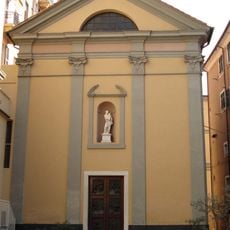
San Venerio, Romanesque church in La Spezia, Italy
San Venerio is a Romanesque church in La Spezia with thick stone walls, rounded arches, and sturdy pillars throughout its interior. The structure features traditional carved stone elements and medieval architectural details typical of northern Italian religious buildings from this period.
A Paleochristian temple existed here before the 5th century, attested by a stone slab. In 1084 the di Vezzano family ordered its rebuilding on late-imperial foundations via a charta donationis; Roman masonry survives in the apse walls. In 1148 Pope Eugene III's bull raised it to pieve under the bishop of Luni.
The church is named after Saint Venerius, a hermit who lived between the 6th and 7th centuries on Tino island. Bishop Leotecarius of Luni had his relics moved here from Tino to protect them from Saracen raiders, and in 860 they were transferred again to Reggio Emilia. A cemetery area surrounds the church, tied to devotion to the hermit saint.
The church stands in via della Pieve, in the Pieve district, on the valley floor once called "della Pieve". A trapdoor in the presbytery leads down to excavations showing a Roman opus incertum wall and an early medieval tomb. The campanile, built around the mid-11th century on the south side, reuses Roman bricks in its facing and holds an internal staircase within the wall thickness.
A hatch in the presbytery opens onto excavations beneath the church, where a Roman wall in opus incertum and an early medieval tomb are visible. The bell tower, built around the mid-11th century on the south side, reuses Roman bricks in its masonry and hides an internal staircase within the wall thickness, an innovative solution for its time.
The community of curious travelers
AroundUs brings together thousands of curated places, local tips, and hidden gems, enriched daily by 93,131 contributors worldwide.