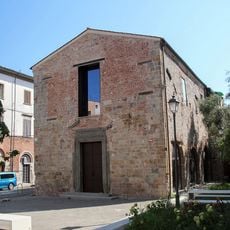
Santa Marta, Baroque church in Pisa, Italy.
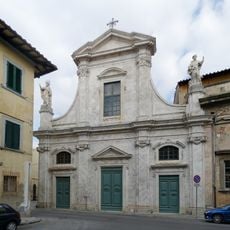
Santa Marta is a church in Pisa with an ochre-plastered facade, two robust pilasters with capitals supporting a triangular pediment, and a rectangular window above the main door, whose marble mouldings are by Giuseppe Vaccà. Inside is a single barrel-vaulted hall lit by side windows, with stucco garlands and cherub heads by Angelo Somazzi and four stucco panels of New Testament stories above carved wooden confessionals.
The church and its now-vanished monastery were founded around 1342 by the Dominican Domenico Cavalca for the Penitent Sisters, who moved here from near the Ponte della Spina. In 1550 Cosimo de' Medici bought the nuns' garden, where Pisa's Giardino dei Semplici stayed until 1595. The monastery was suppressed in 1785, and in 1795 Archbishop Angiolo Franceschi made Santa Marta a priory.
The name Santa Marta comes from the monastery founded here by the Dominican Domenico Cavalca for the Penitent Sisters. The embroidered baldachin the nuns made for 19th-century Corpus Domini processions is lost, and its whereabouts are unknown. The chapel of the Madonna delle Grazie reopened on 14 January 2012 after restoration uncovered its original frescoes.
The building is located in the San Francesco district along its namesake street and can be reached from Via Garibaldi or the Fortezza bridge. Access is possible from several directions, which helps with navigation in the area.
A Crucifixion painting with scenes from the Passion by the Pisan school of the 13th century is preserved here and demonstrates the city's long artistic connection. This work links the interior space to Pisa's earlier religious art tradition.
The community of curious travelers
AroundUs brings together thousands of curated places, local tips, and hidden gems, enriched daily by 94,023 contributors worldwide.