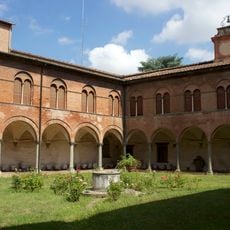
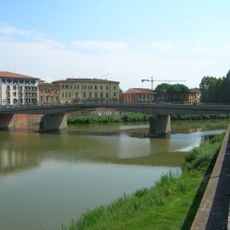
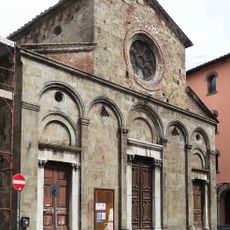
Palazzo Lanfranchi-Toscanelli, Renaissance palace on Lungarno Mediceo, Pisa, Italy.
Palazzo Lanfranchi-Toscanelli is a Renaissance palace on Lungarno Mediceo, built in the first half of the 16th century for Bartolomeo Lanfranchi. Its river-facing facade, redesigned by Francesco Mosca in 1576, has rusticated corner quoins in stone and a mix of different stone materials. The interior was renovated in the 19th century by Alessandro Gherardesca.
In 1505 Bartolomeo Lanfranchi bought a five-storey house with a loggia and well on the Lungarno, and the palace was built in the first half of the 16th century. Giovan Battista Cervelliera restructured it in 1560, and in 1576 Albizzo and Giovanni Lanfranchi rebuilt it with a new river front. The Toscanelli bought it in 1827 and Alessandro Gherardesca gave it its present form.
The Toscanelli, a family of builders from the emerging bourgeoisie, acquired the palace in 1827 and filled it with a painting gallery that included works by Bronzino, Carlo Dolci, Cornelis Bloemaert, Jacques Courtois and Károly Markó the Younger. In the 1830s they employed Giuseppe Bacchini, Luigi Venturini and Benvenuto Brazzini to decorate the rooms. The collection is no longer displayed in the palace.
The residence has served as Pisa's State Archives since 1913, housing historical documents and records. Visitors interested in accessing the archives should check opening hours and researcher requirements beforehand.
Inside are frescoes from the 1860s depicting Lord Byron and Poetry, the Apotheosis of Galileo, and the Apotheosis of Michelangelo by Cianfanelli, Martellini, and Gatti. These painted walls from the 19th century are rarely seen today but reveal the ambitions of the families who once lived here.
The community of curious travelers
AroundUs brings together thousands of curated places, local tips, and hidden gems, enriched daily by 94,230 contributors worldwide.