Chiesa di San Pietro in Castello, Deconsecrated Romanesque church in Ascoli Piceno, Italy
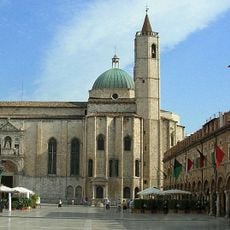
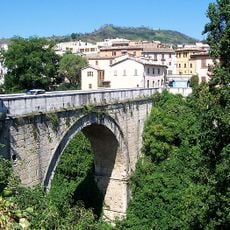
Chiesa di San Pietro in Castello is a deconsecrated Romanesque church on a small rock between Piazza Ventidio Basso and Porta Solestà, facing the Roman bridge over the Tronto. Its severe rectangular facade is split in two and pierced by a lunette-headed entrance, with a triangular bell gable at the upper right and a twelve-ray rose window with twisted colonnettes above the door. Five majolica bowls are set into the wall in a cross above the rose window.
A Lombard bishop, Oderisio, founded a Benedictine church here in the 8th century; the present building was rebuilt in 1142 and consecrated that 9 August by Bishop Presbitero with the bishops of Senigallia and Gubbio. In October 1142 Bishop Rinaldo established a community of Augustinian canons, later confirmed by popes Celestine III and Innocent III. The Comasco masters Giovanni di Ambrogio, Cristoforo di Andrea, Domenico di Donato and Bartolomeo di M. Giacomo rebuilt it between 1466 and 1468; a 1968 restoration returned it to its original style.
The name "in Castello" recalls the castellum de isola, a castle with a defence tower recorded in 1069 on this promontory formed by the Tronto's bed; the tower also served as the church's isolated bell tower, bearing an inscription with that date. Sebastiano Andreantonelli records a second name, San Pietro all'Isola.
The church is accessible on foot and easy to locate near the main plaza and the city gate. The surroundings offer walking paths with views of the Roman bridge and medieval street layout that make exploring this part of the town straightforward.
The facade features an ornate circular window and a rounded entrance arch that arrived during the major renovation period. These decorative elements showcase the artistic choices of the era when the church received its present-day appearance.
The community of curious travelers
AroundUs brings together thousands of curated places, local tips, and hidden gems, enriched daily by 94,648 contributors worldwide.