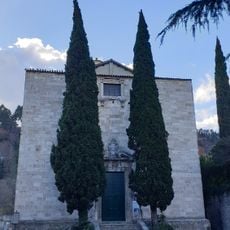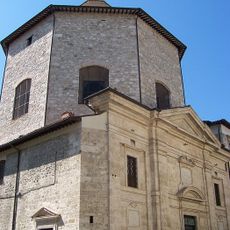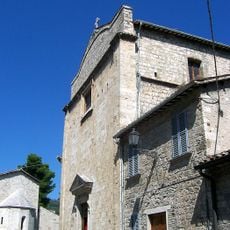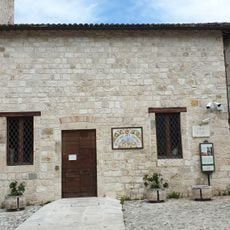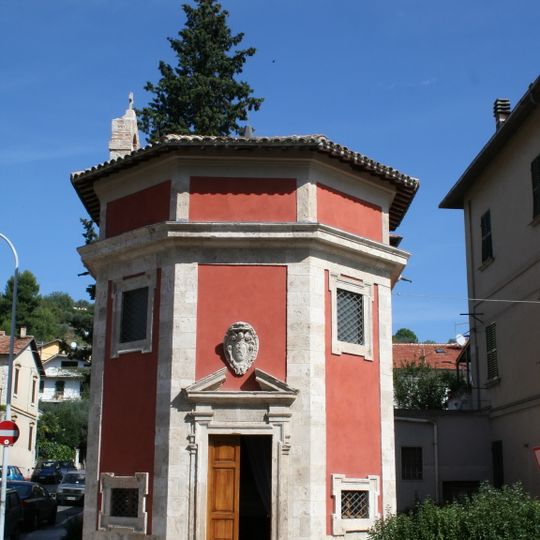
Sant'Emidio Rosso, Octagonal church in Porta Solestà, Ascoli Piceno, Italy
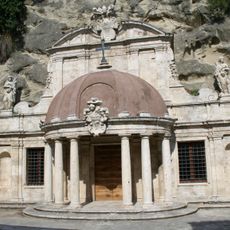
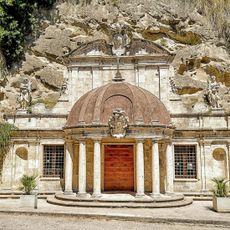
Sant'Emidio Rosso is a small octagonal church outside Ascoli Piceno's old walls, in the Porta Solestà district near the Roman bridge. It is painted red inside and out, a colour recalling the martyr's blood, and sits on a smooth travertine base with windows in its sides. Inside is a single altar, beneath which lies the stone of the saint's decapitation.
The octagonal shrine grew from a votive aedicule that protected the stone of Saint Emygdius's decapitation, known as "la cona de Santo Migno". Cathedral canons paved and enclosed it in 1562 and worked on it again between 1592 and 1594. Bishop Sigismondo Donati had the present building erected in 1633, as the epigraph over the portal records; the identity of its designer remains uncertain.
The stone kept under the single altar is called "la cona de Santo Migno", from the Byzantine Greek eikona, "image", and a nickname meaning small and graceful. It is held to be the rock on which Emygdius laid his head at his decapitation, and it remains the relic of his martyrdom. The octagonal shrine is painted red inside and out, recalling the blood he shed.
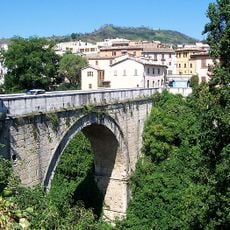
The small octagonal church stands in the Porta Solestà district, a short walk from the Roman bridge and the Fonte di Sant'Emidio, outside the old city walls. It is not a parish church; it is a chapel tied to local devotion, and it is often found open and visited by Ascoli residents. The single altar and the stone beneath it are inside.
The stone kept beneath the single altar is called "la cona de Santo Migno", from the Byzantine Greek eikóna, meaning image or portrait, while Migno describes something small and graceful. Tradition holds it is the rock on which Saint Emygdius laid his head at the decapitation, and it has been kept as a relic of the martyrdom ever since.
The community of curious travelers
AroundUs brings together thousands of curated places, local tips, and hidden gems, enriched daily by 94,123 contributors worldwide.