Cisternone, Water storage building in Livorno, Italy
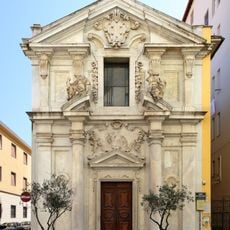
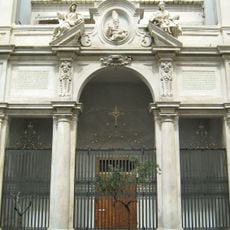
The Cisternone is a neoclassical reservoir built by Pasquale Poccianti between 1829 and 1842 to hold spring water from Colognole. Its pale stone facade has a portico of eight Tuscan columns carrying a coffered half-dome modelled on the Pantheon in Rome. Behind it, the tank is a T-shaped volume split into five aisles by Tuscan pillars under sail vaults, holding 10,000 cubic metres.
Pasquale Poccianti designed the Gran Conserva to store and distribute spring water from Colognole; work ran from 1829 to 1842, with the facade built around 1832 and the coffered half-dome finished in 1837. In June 1833 the dome hosted celebrations for Grand Duke Leopold II's wedding to Princess Maria Antonia, and the reservoir entered service in 1842.
The name Cisternone, "big cistern", distinguishes it from the smaller reservoirs of the aqueduct. In June 1833 the half-dome was finished enough for the wedding celebrations of Grand Duke Leopold II and Princess Maria Antonia to be held here. In 1962 Vittorio De Sica used the facade, dressed with portraits of Hitler, as a Nazi-era German theatre in I sequestrati di Altona.
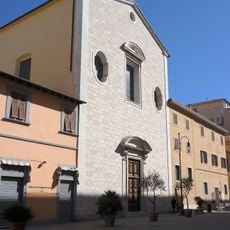
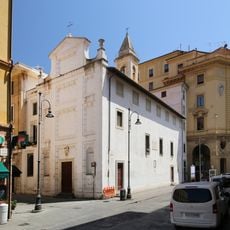
The interior is not open to visitors: the cistern still stores water and is normally closed. The facade can be seen from the piazza beside it, which serves mainly as a parking area at a busy road junction. The strip between the building's right flank and via del Corona is pedestrianized, so it can be approached on foot from there.
The half-dome on the facade has been read as a symbolic reference to the interior, which is normally closed to visitors. The coffered decoration of that niche was only put in place in 1837, five years after the facade was built.
The community of curious travelers
AroundUs brings together thousands of curated places, local tips, and hidden gems, enriched daily by 93,784 contributors worldwide.