Docks Torino Dora, Warehouse complex in Barriera di Milano, Turin, Italy
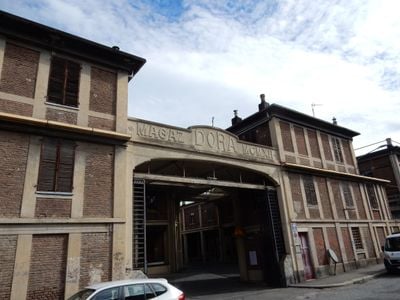
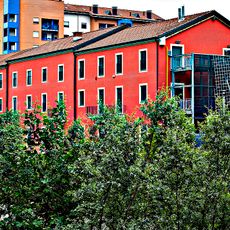
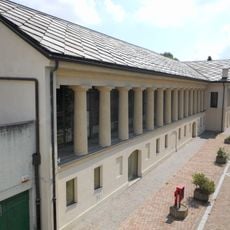
Docks Torino Dora is a general-warehouse complex of 1912–1914 in Barriera di Milano, designed by engineer Ernesto Fantini and built by Giovanni Antonio Porcheddu's firm using the Hennebique reinforced-concrete system. Its red-brick facades, English in inspiration, alternate cream-coloured pilasters and slabs with exposed brickwork; the main entrance on Via Valprato bears the inscription "Magaz. Dora MCMXII" and is covered by a glass-and-concrete velarium. The complex is divided into a southern group of three pavilions on Via Valprato plus a fourth to the north, and a northern area of parallel buildings of differing heights.
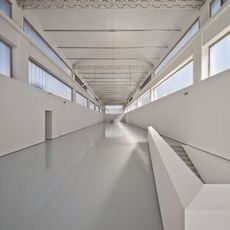
Engineer Ernesto Fantini designed these warehouses between 1912 and 1914 as part of Turin's customs barrier development, known as the Cinta Rossi. The buildings underwent conversion starting in the 1980s and became a center for cultural and creative activities.
The name Docks echoes the English model of the warehouses, and the wrought-iron window grilles carry two interlocking "D" initials. From the 1980s the premises housed contemporary art galleries, private clubs, artist and musician studios, rehearsal and recording rooms, and nightclubs that made the complex a reference point for Turin's underground scene around 2000. The surrounding area appears in the Netflix series Guida astrologica per cuori infranti.
The complex sits at Via Valprato 68 in Turin's northern area and welcomes visitors to explore its galleries and workspaces. It is best experienced during daytime hours when galleries are open and you can move freely through the courtyards.
The buildings employed the Hennebique reinforced concrete system, an early concrete method that was advanced for its time. Originally the site stored duty-free goods such as food and fortified wine before transforming into its current artistic purpose.
The community of curious travelers
AroundUs brings together thousands of curated places, local tips, and hidden gems, enriched daily by 92,940 contributors worldwide.