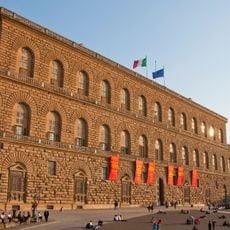
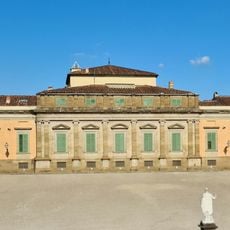
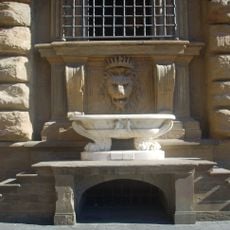
Grotta di Mosè, Renaissance nymphaeum in Palazzo Pitti, Florence, Italy.
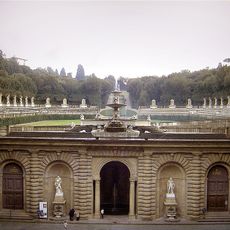
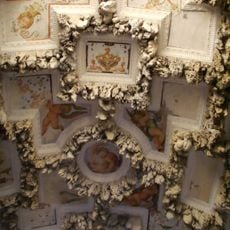
The Grotta di Mosè is a nymphaeum in the Ammannati courtyard of Palazzo Pitti, between the two ramps leading to the Boboli Gardens. Its decoration, dated 1634–1635, includes sixteen pietraforte columns, an elliptical basin, and a colossal Moses in red porphyry carved from an ancient torso with a new body by Raffaello Curradi and Cosimo Salvestrini. Four marble statues stand in niches decorated with spongy limestone concretions.
The space received its decorations between 1634 and 1635 under the direction of architects Giulio and Alfonso Parigi. The work was commissioned by Medici rulers Cosimo II and Ferdinando II.
The four marble Virtues of the Prince were carved in the 1620s and 1630s: Agostino Ubaldini's Charity (1623), Domenico Pieratti's Empire and Zeal (1635–1636) and Antonio Novelli's Law (1635). The allegorical programme was devised by Francesco Rondinelli, scholar and librarian to the grand dukes.
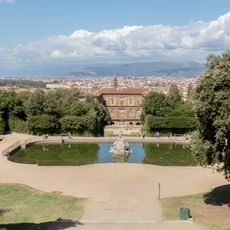
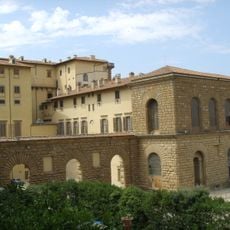
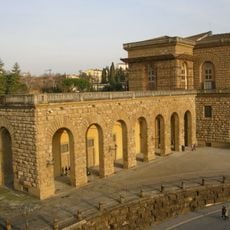
The grotto occupies the Ammannati courtyard, the central court of Palazzo Pitti, set between the two ramps that climb to the Boboli Gardens. Reaching it means entering the palace complex, so a palace ticket is required. The terrace above it holds the Fountain of the Artichoke.
Three marble putti by Pompeo Ferrucci del Tadda swim in the basin, giving the space a playful mythological quality. On the vault above, a painted musical angel simulates a stone pergola open to the sky.
The community of curious travelers
AroundUs brings together thousands of curated places, local tips, and hidden gems, enriched daily by 93,673 contributors worldwide.