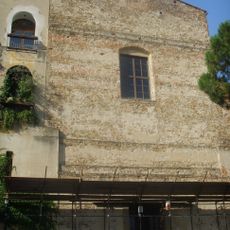
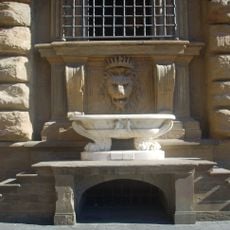
Grotticina della Madama, Renaissance nymphaeum in Boboli Gardens, Florence, Italy
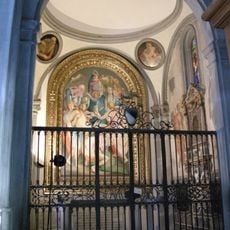
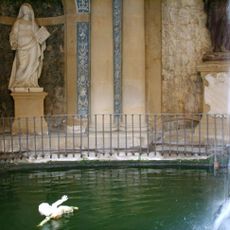
The Grotticina della Madama is a nymphaeum structure in the Boboli Gardens featuring a marble entrance, sponge-like rocks, and a vaulted chamber. The space displays mythological scenes and geometric floor patterns that were carefully designed to create an artistic composition.
Begun before 1550 by Niccolò Tribolo, the grotto was continued by Bartolomeo Ammanati in 1570 and completed between 1583 and 1593 by court architect Bernardo Buontalenti to honour Giovanna of Austria, wife of Francesco I de' Medici. Its ceiling grotesques framed in spongy stone are by Bachiacca and Bernardino Poccetti (1555), and the floor was entrusted to Santi Buglioni.
The grotto is also called delle Capre, "of the goats", after the four marble goats above the basin that once spouted water. The goat was a symbol of Giovanna d'Austria's father-in-law Cosimo I de' Medici, shown as the virile emblem of the dux, and it also recalls Amalthea, the goat that nursed Jupiter. The ceiling grotesques in frames of spongy stone are by Bachiacca and Bernardino Poccetti (1555).
The grotto sits at one end of the Giardino di Madama, a small flowered parterre with geometric beds inside the Boboli Gardens, reached from the garden entrances by walking up through the amphitheatre area. The marble doorway is set off-axis from the interior, so the entrance looks like a descent underground although the building is at ground level. Look for the spongy rockwork and stalactites covering the surfaces.
The ceiling displays intricate grotesque paintings framed by spongy stones, creating a striking blend of natural and artistic elements. Four marble goat statues placed within represent a dual reference to both Cosimo I de Medici and the mythological figure Amalthea.
The community of curious travelers
AroundUs brings together thousands of curated places, local tips, and hidden gems, enriched daily by 94,019 contributors worldwide.