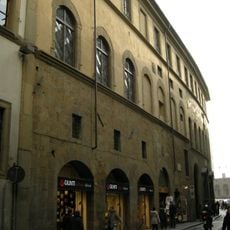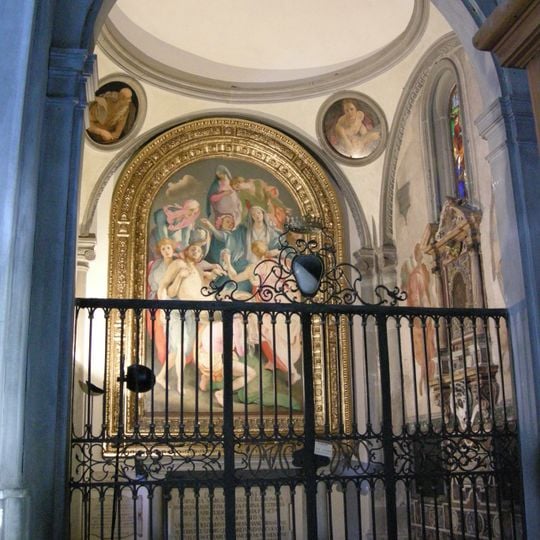
Capponi Chapel, Renaissance chapel in Oltrarno, Florence, Italy.
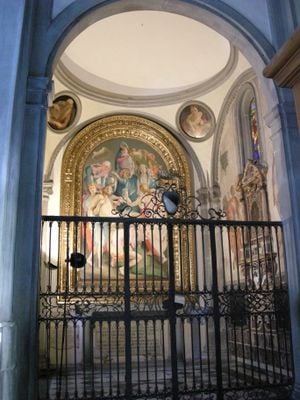
The Capponi Chapel, immediately to the right of the entrance in Santa Felicita, is a square, vaulted chamber designed by Filippo Brunelleschi. Its walls are pale grey limestone, with double Ionic semicolumns at the corners and round arches that once supported a hemispherical dome on pendentives. The dome was rebuilt in 1765–1767, and the pendentives now hold Pontormo and Bronzino's frescoes of the Evangelists. A tall black wrought-iron gate with scrollwork and a small bell-like vessel stands before the gold-framed altarpiece.
The chapel was constructed in the early 1420s as a commission from the Barbadori family to the architect Filippo Brunelleschi. Its design marked a turning point in Renaissance building, introducing mathematical precision and classical proportions where medieval freedom had previously ruled.
The chapel changed name and purpose with its owners: the Barbadori founded it, the Paganelli sold it in 1525 to Lodovico di Gino Capponi, who lived nearby in via de' Bardi. He rededicated it from the Annunciation to the Pietà, a theme suited to the burial place he was preparing for himself and his family, and ordered five weekly masses. The wrought-iron gate of 1722 carries the Capponi coat of arms.
The chapel sits within the Santa Felicita church on Via de' Bardi in the Oltrarno district, and is easily spotted once inside. Since it is a functioning religious space, quieter behavior and respectful observation are expected from visitors.
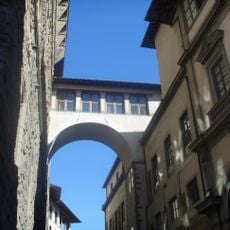
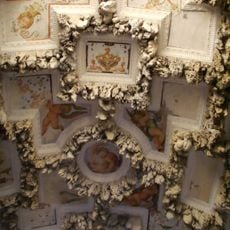
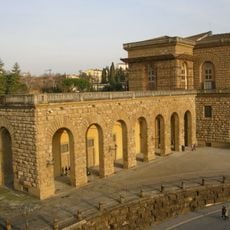
The chapel's hemispherical dome was destroyed in 1765-1767 to make room for the prince's balcony along the Vasari Corridor; the original Brunelleschian cupola and Pontormo's fresco of God the Father were lost. The 2018 restoration uncovered Domenico Stagi's architectural decoration of the inner dome, dating to about 1770.
The community of curious travelers
AroundUs brings together thousands of curated places, local tips, and hidden gems, enriched daily by 93,170 contributors worldwide.