Kolymbetra, Mediterranean garden in Valley of Temples, Italy
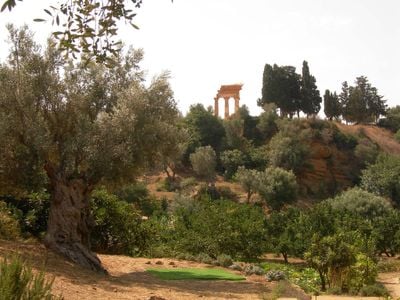
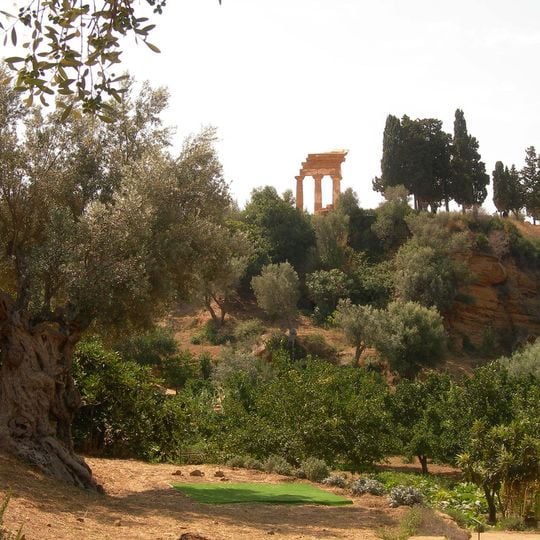
Kolymbetra is a garden of just over five hectares in a small valley in the Valley of the Temples, on dry, pale brown earth. A gnarled grey-brown trunk with a broad green canopy stands at the edge, and a flat oval of mown grass lies on the bare ground. Densely planted trees and shrubs cover the slope, with citrus groves, almond and olive trees, and Mediterranean scrub.
Diodorus Siculus records that after the Battle of Himera in 480 BC, the tyrant Theron had the pool built using many slaves captured in battle; the same workforce dug the hypogea, galleries that collected water seeping from porous calcarenite and channelled it to the basin. A century later the pool was filled in and turned into a cultivated garden, and the hypogea were adapted to feed a small irrigation basin, a system still working today.
The name comes from the Greek kolymbethra, a pool for water games, and Diodorus Siculus records that after the pool was filled in it became a cultivated orchard. Water still reaches the garden through the hypogea, the tunnels cut into the porous calcarenite, feeding a small basin or gebbia beside a tunnel mouth that irrigates the plots. The FAI restorations replanted around 1,500 trees documenting 300 almond varieties.
Visitors enter through a gate near the Temple of Castor and Pollux, where paths lead through fruit groves and olive plantings. The ground can be uneven, especially after rain, so comfortable walking shoes are recommended.
The garden preserves rare citrus varieties like Sanguigno oranges and Femminello lemons that are disappearing from the world. These specific types grow in only a few places today, making this location a living seed bank for these plants.
The community of curious travelers
AroundUs brings together thousands of curated places, local tips, and hidden gems, enriched daily by 94,243 contributors worldwide.