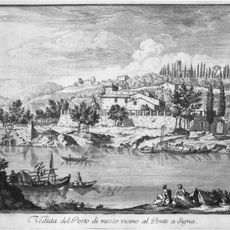
Gonfolina, River gorge in Lastra a Signa, Italy
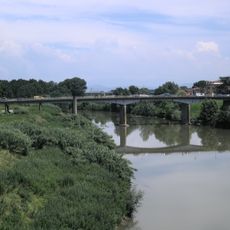
Gonfolina is a sandstone ridge that narrows the Arno River into a tight passage, creating a distinct landmark where the valley shifts direction. The formation separates the Middle Valdarno from the Lower Valdarno and sits where the Ombrone stream joins the river.
The sandstone mass of the Gonfolina, still visible today, once blocked the Arno and, according to some geologists, created a large lake extending to present-day Florence, Prato and Pistoia. Modern studies attribute the lake's emptying to erosion and sediment buildup rather than human intervention. A tradition reported by Antonio Ricci in 1895 claims the Romans broke the rock to drain the lake. An epigraph on the mass records Leonardo da Vinci's description of the ancient barrier.
The rock is also called the "Rock of the Fairies" (Masso delle Fate) in local tales. A modern epigraph on the masso quotes Leonardo da Vinci's description of the Gonfolina as an ancient dam that once held back two large lakes. The name Golfolina comes from the Latin gulfus, from Greek kolpos, "gulf" or "bosom".
The Gonfolina lies along the SS 67 at kilometre 64.5, between La Lisca and Brucianesi in the comune of Lastra a Signa, just before the Ombrone flows into the Arno. The narrow passage is visible from the road; the Masso della Gonfolina, bearing a modern epigraph quoting Leonardo da Vinci, stands beside it.
The name connects to ancient Greek words describing a gulf or hook, reflecting how the rock curves into the river. Local folklore knows the formation as the 'Rock of the Fairies' due to its unusual shape that captures the imagination.
The community of curious travelers
AroundUs brings together thousands of curated places, local tips, and hidden gems, enriched daily by 93,036 contributors worldwide.