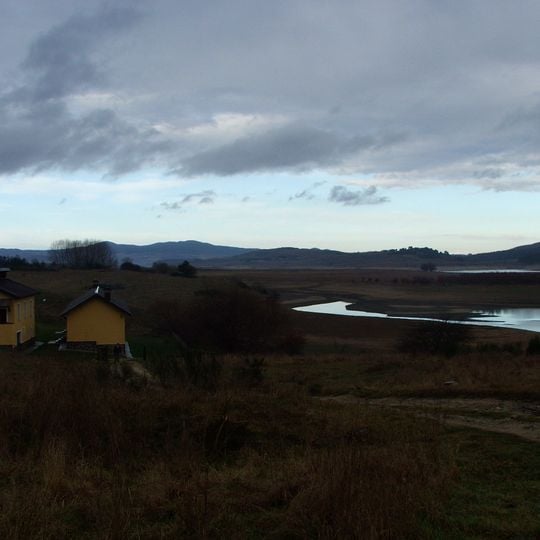
Lago Cecita, Mountain reservoir in Province of Cosenza, Italy
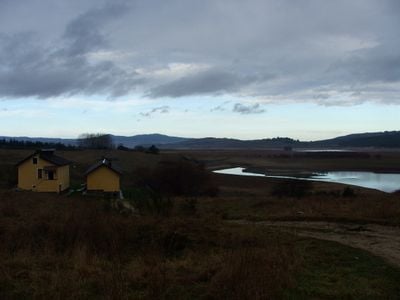
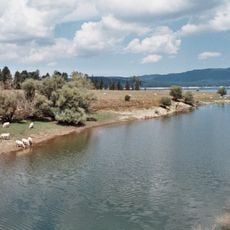
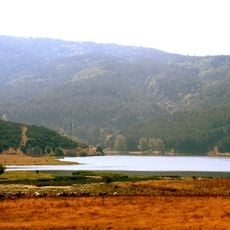
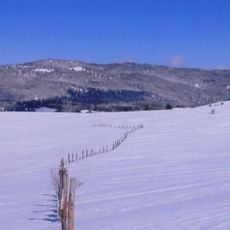
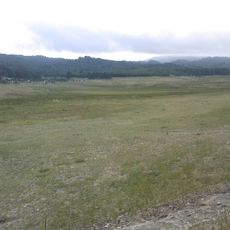
Lago Cecita is an artificial reservoir in the Sila Grande, in the province of Cosenza, formed by damming the Mucone River. It lies at 1,143 metres above sea level and is the largest lake of the Sila plateau, with a capacity of 108 million cubic metres, a surface of 12.6 square kilometres and a shoreline of 46 kilometres. The water fills a broad basin between low earthen banks, narrowing into a winding channel at one end.
Work on the dam began in 1949, carried out by the Lodigiani company for the S.M.E. of Naples, and was finished at the end of 1952; the Cecita valley and its creek gave the dam and lake their name. After the nationalisation of electricity in 1962 the plant passed to Enel, and in 1999 to Enel Produzione and later Enel Green Power. The Acri and Luzzi power stations, built 1949-1955, use the water before returning it to the Mucone.
The lake takes its name from the Cecita valley and the Cecita creek, a tributary of the Mucone, which the dam flooded. Its water irrigates the surrounding fields, where potatoes are the main crop. The reservoir lies on the western border of Sila National Park, and the Mucone flows both into and out of it.
The lake lies at 1,143 m on the western border of Sila National Park, with banks in the municipalities of Spezzano della Sila, Longobucco and Celico. The dam stands in the Cecita valley near Camigliatello Silano. Approach by road from Camigliatello Silano; the water level drops markedly between maximum and minimum drawdown, exposing wide mudflats.
The dam that holds the lake is a double-curvature arch-gravity structure in concrete, 55 metres high at its deepest foundation point and 166.15 metres long along the crest, standing in the Cecita valley in the comune of Celico. Its body alone contains 44,000 cubic metres of concrete.
The community of curious travelers
AroundUs brings together thousands of curated places, local tips, and hidden gems, enriched daily by 92,869 contributors worldwide.