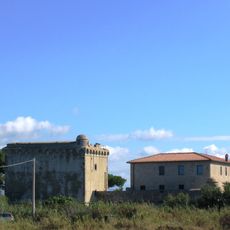
Mausoleo Vivarelli, Art Nouveau mausoleum in Talamone, Italy.
Mausoleo Vivarelli is a travertine-clad tower tomb in the front right corner of Talamone's small cemetery, visible from the road. Its upper level has large heart-shaped openings partly filled with stone tracery, above which an octagonal drum carries a flattened brick bulb dome. A double staircase with an Art Nouveau wrought-iron balustrade leads to the upper chapel, while the crypt entrance sits at ground level.
Jader Vivarelli, born in Montiano in 1836 and a leading figure in the Talamone land-reclamation works, commissioned the mausoleum together with its furnishings before his sudden death at Bengodi in 1904. The Grosseto architect Lorenzo Porciatti designed it in collaboration with Vivarelli himself, and it was built between 1905 and 1906.
The heart-shaped windows, partly filled with stone tracery, and the flattened brick bulb dome give the tomb an orientalising, neo-romantic register that sits out of scale with the small cemetery. The wrought-iron balustrade of the double staircase, with volutes and curved Art Nouveau lines, contrasts with the solid travertine tower behind it. A monumental white marble bust of the founder, Jader Vivarelli, is kept in the upper chapel.
The mausoleum sits within the Talamone cemetery and remains easy to spot as you approach the burial grounds from the access road. Keep in mind that this is an active cemetery, so visitors should respect local customs and any posted guidelines.
The polychrome glass panes that once filled the heart-shaped windows and the octagonal drum are gone, destroyed by an explosion of charges set off nearby; the openings were then walled up. The precious wooden benches inside were also wrecked and had to be removed.
The community of curious travelers
AroundUs brings together thousands of curated places, local tips, and hidden gems, enriched daily by 93,588 contributors worldwide.